Safe Space or Simplest Shelter: How to Formalise Basement Premises and Operate During the Yellow Level
Basement premises may be formalised as a safe space or included in the civil-protection shelter fund as a simplest shelter. This article explains the difference between these regimes, the formalisation procedure, access requirements and whether a business may operate during the yellow level after the three-month transition period.
Summarize this article with AI:
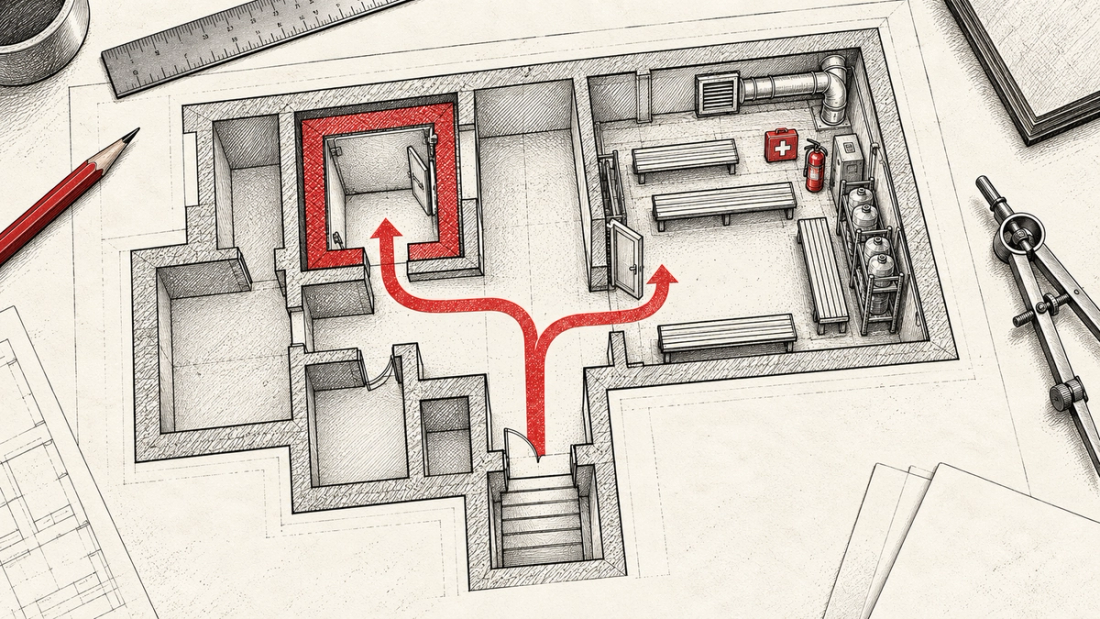
A basement-level premises may potentially be used under two different legal regimes: as a safe space or as a simplest shelter. These concepts are not interchangeable. They have different formalisation procedures, legal status, access requirements and consequences for the balance-sheet holder.
This issue has become particularly important following the introduction of yellow and red air-threat levels. The general algorithm for business operations under the new rules is explained in “Air-Raid Alerts at Work: Yellow and Red Levels”.
Short answer
- A safe space allows a business to continue operating during the yellow level if the space has been designated by the balance-sheet holder, its protective properties have been confirmed by calculations, and the premises has been equipped in accordance with those calculations.
- After the three-month transition period expires, a business may operate during the yellow level if the site already has a properly established safe space or shelter.
- A simplest shelter is an asset of the civil-protection shelter fund. An internal company order or an inspection report by an internal commission is not enough to obtain this status: a decision by the relevant record-keeping authority is required.
- For the red level, Resolution No. 1092 does not establish a general right to continue normal operations either in a safe space or on the basis of temporary workforce approval.
Option 1. Safe space
The safe-space mechanism was introduced by Cabinet of Ministers Resolution No. 1092 of 4 September 2026, as amended by Cabinet of Ministers Resolution No. 1128 of 15 September 2026.
A safe space consists of the most protected areas within premises, buildings or structures designated by the balance-sheet holder. They must protect employees and visitors from the indirect effects of conventional weapons and from the specified maximum blast overpressure.
The existence of such a space must be confirmed by calculations performed by the balance-sheet holder. An internal order, a sign, a windowless basement or reliance on the “two-wall rule” alone is not sufficient.
What a safe space allows a business to do
During the yellow level, a business may continue operating if the premises or building contains a properly equipped safe space.
The three-month transition period applies when there is neither a shelter nor a safe space. In that case, the business may temporarily operate during the yellow level with workforce approval, but for no longer than three months from the date Resolution No. 1092 entered into force.
After that period expires, workforce approval alone is no longer sufficient. To continue operating during the yellow level, the site must have a shelter or a safe space created in accordance with the Resolution.
Status and access
A safe space is not a simplest shelter and is not included in the shelter fund under the procedure established by Cabinet of Ministers Resolution No. 138. Resolution No. 1092 does not require it to be registered with a local authority or the State Emergency Service of Ukraine.
The space must be designed to protect not only employees but also visitors present on the premises. Resolution No. 1092 does not require general access for people who are not on the business premises.
At the same time, access by third parties must be assessed in light of local decisions and civil-protection rules. An absolute rule stating that “outsiders are never admitted under any circumstances” is therefore risky.
How to formalise a safe space
Step 1. Identify the most protected part of the building. A basement-level premises may be a candidate, but its location alone does not prove its protective properties.
Step 2. Calculate its protective properties. The calculation must confirm protection from the indirect effects of conventional weapons and from the maximum blast overpressure.
Step 3. Equip the space in accordance with the calculation: implement the necessary technical measures and determine capacity, routes, access arrangements and rules for occupants.
Step 4. Place a 100 × 60 cm sign bearing the prescribed Ukrainian wording “Об’єкт забезпечений безпечним простором” at the entrance to the premises, building or territory, or on an external wall or fence.
Step 5. Approve a procedure for responding to an air-raid alert, designate responsible persons and ensure that employees and visitors receive the alert.
The Resolution refers to calculations performed by the balance-sheet holder but does not prohibit engaging a design, expert or other qualified organisation to perform them. Given the technical nature of the calculation, involving a relevant specialist is justified.
The problem with the blast-overpressure value
The maximum pressure value for the yellow level must be determined by the Ministry of Defence and the General Staff of the Armed Forces of Ukraine. The Ministry of Internal Affairs, the State Emergency Service and the Ministry for Development of Communities and Territories must communicate it, including to businesses, design organisations and expert organisations.
As of the date this article was prepared, no officially published numerical value for this indicator was found on the websites of the Ministry of Defence, the Ministry of Internal Affairs or the State Emergency Service. Without the relevant official document, it is therefore impossible to confirm a specific value or the final correctness of a calculation.
Resolution No. 1092 also contains no separate procedure for submitting a calculation to, or obtaining approval from, a public authority.
What to do during the red level
Resolution No. 1092 establishes a special right for businesses to continue operating specifically during the yellow level. It contains no equivalent general permission for the red level.
A safe space should therefore not be presented as a sufficient legal basis for continuing normal operations during the red level. A business must separately establish a procedure for stopping work, safely shutting down processes, and directing employees and visitors to an appropriate asset of the shelter fund.
A route to the nearest municipal shelter may form part of the red-level procedure, but it does not itself replace a safe space or shelter for the purpose of continuing operations during the yellow level.
Option 2. Simplest shelter
A simplest shelter is an asset of the civil-protection shelter fund. A business cannot finally grant this status to a basement-level premises on its own: a decision by the relevant record-keeping authority is required.
How to include the premises in the shelter fund
Step 1. Establish a commission to inspect the premises. Basement and semi-basement floors of civil and industrial buildings are among the premises that may be inspected for use as simplest shelters.
If the premises is owned or managed by the business, the business itself may establish the commission. Officials of the State Emergency Service and other specialists may be involved upon request. The regulation does not require a State Emergency Service representative to participate in every inspection.
Step 2. Inspect the premises and prepare a report using the form prescribed by the requirements for accounting for the shelter fund approved by Ministry of Internal Affairs Order No. 579.
- The commission’s report does not mean that the business has already assigned shelter status to the premises. It provides the basis for applying to the record-keeping authority.
Step 3. Attach technical documents where necessary. Calculations of protective properties may be attached to the report. If the commission recommends a technical survey, the facility passport or a survey report must also be provided.
The standards and methods in force on the inspection date must be used. DBN V.2.2-5:2023 is marked as archived on the official e-construction portal, so its applicability to a specific calculation should be checked before work begins.
Step 4. The balance-sheet holder submits the report and other required documents to the record-keeping authority.
- For privately owned facilities, the decision on inclusion is made by the local authority. District state administrations perform this function only in Kyiv and Sevastopol. A universal instruction to “submit the documents to the district state administration” is therefore incorrect.
- The record-keeping authority must review the materials within no more than 20 working days and notify the balance-sheet holder of its decision.
Step 5. Following a positive decision, an administrative document is issued to include the premises in the shelter fund. Only then does it acquire the official status of a simplest shelter.
The requirements under Ministry of Internal Affairs Order No. 579 provide for this document to be issued within 20 working days of the decision. Separately, paragraph 21 of Procedure No. 138 requires information to be entered into the Information System within five working days after the decision. These are two different time limits.
Consequences of simplest-shelter status
Public access
Relevant population groups must have round-the-clock and unobstructed access to a shelter-fund facility that has been brought to readiness.
The law does not use the wording “anyone who wishes”. People may be allocated to shelters on a territorial, workplace-based or mixed basis. At the same time, exclusive use by the business’s employees cannot be guaranteed: during martial law, authorised bodies may arrange shelter for third parties where space and access are available.
Readiness
Shelter-fund facilities must be brought to readiness within no more than 24 hours after the relevant legal regime is introduced. Because the special period is already in effect, premises included in the fund must in practice be maintained in a ready condition at all times.
Equipment
The premises must provide seating or lying places, lighting, ventilation, drinking-water reserves, sanitary supplies, initial firefighting equipment, a first-aid kit, communication equipment and other items required by the current provisions of Ministry of Internal Affairs Order No. 579.
Responsible person and signage
A responsible person must be appointed and a 50 × 60 cm sign with the prescribed Ukrainian wording “Місце для УКРИТТЯ” or “Найпростіше укриття”, together with the required information, must be placed near the entrance.
Periodic inspections
The balance-sheet holder conducts quarterly inspections, prepares a report and registers it in the relevant log. This requirement is established by Ministry of Internal Affairs Order No. 579, not by part 15 of Article 32 of the Civil Protection Code.
Oversight and liability
The facility may be inspected by the State Emergency Service and other authorised bodies. The owner, user and balance-sheet holder are liable for violations of the requirements governing the maintenance and operation of a shelter-fund facility.
The main difference between the two options
- A safe space is not part of the shelter fund, does not undergo the inclusion procedure under Resolution No. 138, and is used to protect employees and visitors at the site during the yellow level.
- A simplest shelter has official shelter-fund status, is recorded by the authorised body, must be maintained in a state of readiness, and is subject to a defined public-access regime.
- For a safe space, the key requirements are a technically substantiated calculation and actual fitting-out. A simplest shelter additionally requires official inclusion in the fund, record-keeping, regular inspections and oversight.
Which option should a business choose?
If the main objective is to protect employees and visitors and obtain the legal ability to continue operating during the yellow level without adding the premises to the shelter fund, establishing a safe space may be considered.
However, an internal order and a sign are not enough. A technically substantiated calculation is required, the premises must be equipped accordingly, and the maximum number of employees and visitors who may be in the building at the same time must be taken into account.
Including the premises in the fund as a simplest shelter is appropriate if the business is prepared to ensure permanent readiness, proper equipment, periodic inspections, oversight by authorised bodies and access for the designated population groups.
RACIO can handle the practical part of this task: prepare civil-protection documentation, develop occupational-safety documentation, and provide fire-safety and evacuation training for personnel.
Legal basis
- Cabinet of Ministers Resolution No. 1092 of 4 September 2026
- Cabinet of Ministers Resolution No. 1128 of 15 September 2026
- Cabinet of Ministers Resolution No. 138 of 10 March 2017
- Ministry of Internal Affairs Order No. 579 of 9 July 2018 — requirements for maintaining and operating shelter-fund facilities
- Ministry of Internal Affairs Order No. 579 of 9 July 2018 — requirements for accounting for the shelter fund
- DBN V.2.2-5:2023 on the official e-construction portal (status: archived)

Let’s discuss
your project
Leave your contacts — a RACIO engineer will call and answer your questions.