Air-Raid Alerts at Work Under the New Rules: Yellow and Red Levels, Shelters and Safe Spaces
Cabinet of Ministers Resolution No. 1092 of 4 September 2026 changed the rules for responding to air-raid alerts. Employers must now distinguish between yellow and red levels, verify the status of the premises, define the alert procedure and assign in writing the actions of staff, visitors and responsible persons.
Summarize this article with AI:
Until September 2026, most businesses followed one procedure: hear the siren, stop work and go to a shelter. Cabinet of Ministers Resolution No. 1092 introduced two air-threat levels, while Resolution No. 1128 clarified the requirements for alerts, premises and business actions.
Employers now need to answer three questions rather than one:
- Which threat level has been announced — yellow or red?
- Does the facility have a shelter, a dual-purpose structure or a properly designated safe space?
- Which approved procedure applies specifically at this facility?
What Resolution No. 1092 changed
The air-raid alert now has two levels:
Level — Threat — Signal duration
Yellow — drone threat — 30 seconds
Red — missile, combined missile-and-drone or mass drone threat — 1 minute
The alert consists of the “Attention everyone” audible signal and a voice message identifying the threat level. The yellow level is issued by individual districts. The all-clear is delivered by voice message without the “Attention everyone” audible signal.
For multi-site businesses, this means that stores, offices or warehouses in the same region may operate under different regimes at the same time. A general message in the corporate chat is not enough: each facility must monitor the alert for its own district.
Can a business continue working during the yellow level?
Yes, but only under the conditions established by Resolution No. 1092 as amended by Resolution No. 1128.
A business may continue operating during the yellow level if the building, premises or site has at least one of the following forms of protection:
- a civil-protection shelter structure;
- a temporary or permanent shelter for staff and visitors;
- a dual-purpose structure;
- a safe space within the building or premises.
The mere presence of a basement, car park, windowless corridor or “two walls” does not mean that the facility has a safe space within the meaning of Resolution No. 1092.
What is a “safe space”?
The Resolution defines it as the most protected areas within premises, buildings or structures designated by the balance holder. These areas must be arranged within the existing spatial and planning layout and provide protection from the secondary effects of conventional weapons and the specified maximum blast overpressure.
Therefore, a tenant’s director cannot designate a meeting room as a “safe space” by order alone. At minimum, the following are required:
- a decision or confirmation from the balance holder designating the specific area;
- the calculation on which the designation is based;
- a layout and route plan;
- information on capacity and accessibility;
- notification of staff and visitors that the space is available.
The “two-wall rule” remains an emergency risk-reduction measure when a person cannot reach a shelter in time. It does not replace a formally designated safe space.
What should a business without a shelter do?
If there is no temporary or permanent shelter in the premises or on the site, the Resolution permits operations to continue during the yellow level:
- only with the agreement of the workforce;
- until a shelter is arranged;
- but for no longer than three months from the date Resolution No. 1092 entered into force.
This does not mean that the business must automatically close or terminate its lease after three months. What expires is the temporary legal basis for continuing to operate at that facility during the yellow level with the workforce’s agreement.
There is a legal inconsistency here. Following the amendments introduced by Resolution No. 1128, work during the yellow level is also permitted where a safe space is available. However, the transitional three-month provision still refers specifically to “arranging a shelter”. Without an official clarification, it should not be claimed that any safe space automatically satisfies the three-month requirement.
For a leased office, store or warehouse, the first step is a written request to the owner or balance holder. The business needs documents confirming the status of the shelter or safe space, its capacity, access, routes and alert procedure — not an oral response from an administrator.
Download a sample letter to the landlord (Ukrainian-language document)
What to do during the red level
Resolution No. 1092 expressly describes a special permissive operating regime for the yellow level. This regime cannot automatically be extended to the red level.
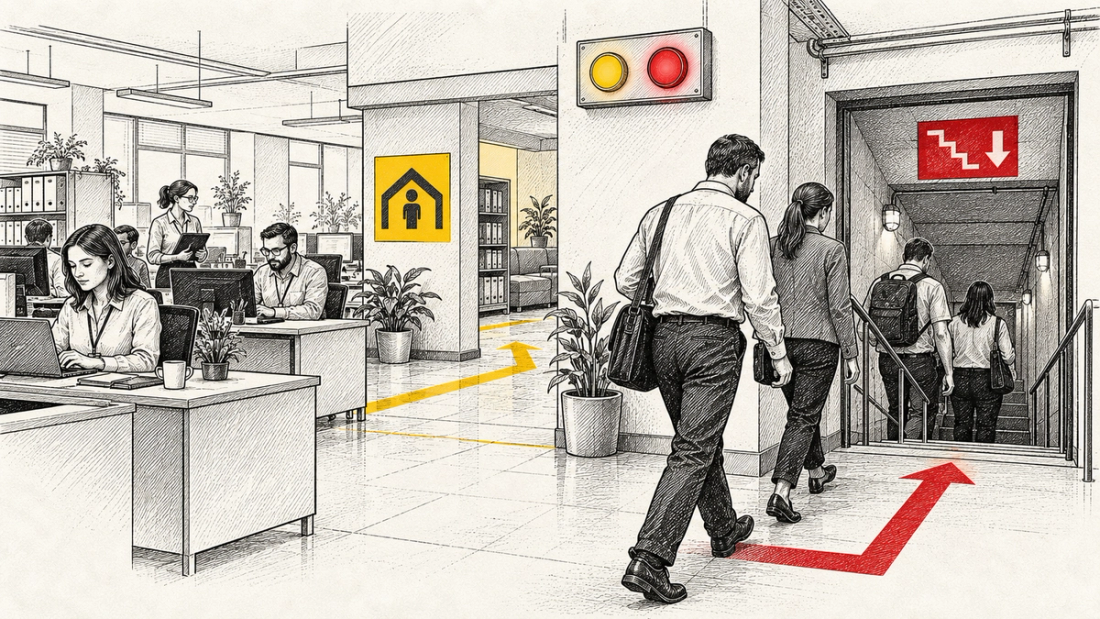
For an ordinary business, the safe internal procedure should be:
- Stop work.
- Perform only the actions required to shut down equipment or processes safely.
- Move staff and visitors to the designated shelter in an orderly manner.
- Resume work after the all-clear and a safety check of the facility.
If a process cannot be stopped immediately, the business must define in advance how it will be brought to a safe state, who is responsible and the maximum time allowed. An oral decision by a supervisor during an alert is not a substitute for such a procedure.
The Cabinet of Ministers or sector authorities may establish special rules for individual industries. These must be considered separately from the business’s general procedure.
An entrance sign is now mandatory
The balance holder and the business operator must inform staff and visitors about the facility’s protection status. A 100 × 60 centimetre sign must be placed at the entrance, on an external wall or on the perimeter fence with one of three statements:
- “The facility is provided with a shelter”;
- “The facility is provided with a safe space”;
- “The facility is not provided with a shelter”.
A tenant cannot shift this issue entirely to the business centre. The Resolution names both the balance holder and the business operator. The letter to the landlord should therefore immediately establish who will produce the signs and where they will be placed for the building and for tenants’ separate entrances.
Who must communicate the alert?
Relying only on apps on employees’ phones is not sufficient. The business operator or balance holder must ensure that the signal reaches staff and visitors.
The order must define:
- the primary alert channel: loudspeaker, internal system, hand-operated siren or an announcement by the duty officer;
- a backup channel in case of a power or communications outage;
- the responsible person and their substitute;
- how people in toilets, storage areas, technical rooms and remote areas will be notified;
- how visitors, contractors and drivers will be notified.
Which documents must be prepared?
One order is not enough. A practical package for a business consists of the following documents:
- An order organising actions during an air-raid alert.
- A procedure for yellow and red levels as an annex to the order.
- A shelter or safe-space plan and movement routes.
- Documents from the balance holder concerning the shelter or safe space.
- Minutes or another document recording agreement with the workforce where the temporary operating regime without a shelter is used.
- Employee acknowledgement sheets.
- A short acknowledgement sheet for visitors and contractors.
- Confirmation that the mandatory 100 × 60 centimetre sign has been installed.
- A list of processes that require time for a safe shutdown and separate instructions for them.
Download a sample order and procedure (Ukrainian-language document)
Download the employee acknowledgement sheet (Ukrainian-language document)
Download the visitor and contractor acknowledgement sheet (Ukrainian-language document)
Download a sample workforce agreement record (Ukrainian-language document)
What tenants should check now
Do not rely on the landlord’s statement that “there is a shelter somewhere in the building”. Check:
- the legal and actual status of the premises;
- whether it is opened during every alert;
- whether capacity is sufficient for all tenants and visitors;
- how long relocation actually takes;
- whether the route is accessible to people with disabilities and those who need assistance;
- who is responsible for keys, lighting, ventilation and backup power;
- whether alert procedures are coordinated between building management and tenants;
- who installs the 100 × 60 centimetre sign;
- whether the tenant has received copies of the documents referenced in its own order.
The nearest metro station or municipal shelter may be part of the route, but a distance of “seven minutes on foot” does not itself demonstrate compliance. Accessibility, capacity, travel time and the ability of all staff and visitors to reach it safely must be checked.
Must employees acknowledge the procedure in writing?
Yes. Employees must know not only the shelter address but also the difference between the two levels, the alert method, the route, how to stop their own work and the assembly point.
Written acknowledgement does not replace a drill. Every shift should walk the route and check doors, keys, lighting, communications and the actual relocation time.
Conclusion
Resolution No. 1092 allows businesses to avoid stopping work for every drone threat, but ties this option to specific organisational and technical conditions. The weakest approach is simply to rename an internal corridor a “safe space” and issue an order.
The workable approach is different: obtain documents from the balance holder, define the regime for yellow and red levels, install the sign, provide an internal alert system, approve the procedure and brief everyone.
RACIO develops these packages for specific offices, stores, warehouses and production facilities: it verifies the facility’s source data, prepares orders and procedures, drafts requests to the landlord and conducts route drills with staff.
To implement these requirements systematically, RACIO provides: civil protection documents and training, occupational safety documentation development and practical fire-safety and evacuation training.
Legal basis
- Cabinet of Ministers Resolution No. 1092 of 4 September 2026
- Cabinet of Ministers Resolution No. 1128 of 15 September 2026
- Law of Ukraine “On Labour Protection”, Articles 13 and 18
- Civil Protection Code of Ukraine
Let’s discuss
your project
Leave your contacts — a RACIO engineer will call and answer your questions.