"We've been hit." A strike on your facility: how to prepare when help won't come?
A practical checklist for managers and occupational safety teams: utilities, firefighting, communications, medical supplies, staff roles and legal protection, based on the experience of facilities that have already been hit.
Summarize this article with AI:
The first minutes after an explosion. The power is out, the mobile network is dead, the fire extinguisher by the entrance is riddled with shrapnel, and the blast wave has warped the evacuation doors. The air raid alert is still on, and State Emergency Service (DSNS) crews and ambulances won't leave their stations until it's over. On site are your people: frightened, disoriented, possibly injured.
Let's be honest: no "Emergency Response Plan" sitting in a cabinet describes this scenario.
We recently spoke with the people in charge at facilities that have been hit and damaged over the past few weeks. The main takeaway from their experience is harsh but honest: in the first minutes and hours, you can only count on yourselves. Outside services may not arrive right away, communications go down, and standard equipment often fails under the blast wave.
So we turned their experience into a step-by-step algorithm. You can use it as the basis for an internal procedure or instructions for your branches and network. Let's go through it.
Step 1. Utilities: who shuts off what
After a strike, gas and electricity are no longer utilities. They are sources of new danger. So:
- Clearly mark the location of the gas metering point and the transformer substations (TP, 10 kV and 0.4 kV).
- Assign people responsible for emergency shutoff, and backups. A person may be injured, in acute stress, on leave, or simply off shift. A backup is not a formality.
- Brief your staff: where to shut off, in what order, and where not to go. Walk the whole briefing through the site on foot. Repeat it several times.
Important: if you have switched life-support systems to a generator (and many have, after the outages), then to fight a fire at the 0.4 kV TP panel you must switch off all equipment except the fire pumps, which must keep running on the generator. This detail deserves its own line in the instructions, because it's the first thing people forget under stress.
As for the 10 kV TP, the power company usually shuts it off right after a fire report. Staff shouldn't go near it. At all.
Step 2. Firefighting: reality instead of theory
Fire extinguishers
The practice is unpleasant: a powerful blast wave often deforms the extinguisher valves or sets them off on their own. So at the critical moment, some extinguishers may turn out to be useless. The conclusion: don't rely only on the ones inside the building. Keep a separate reserve in the shelter or away from the main production areas.
Fire cabinets
The blast wave jams fire cabinet doors, and you can't reach the fire hose the standard way. Facilities that have run into this install convenient handles or "push plates" on the doors. Yes, this may contradict the view of your fire safety engineer or the State Emergency Service (DSNS), but experience shows you most likely won't open a deformed cabinet by its standard small handle.
Hydrants, motor pumps and manholes
Check your hydrants, but don't count on stationary fire pumps or on firefighters arriving during an alert. What actually helps:
- Your own motor pump (better two) on site.
- A stock of hoses and standpipes sized to the real distance to the fire water source you can pump from.
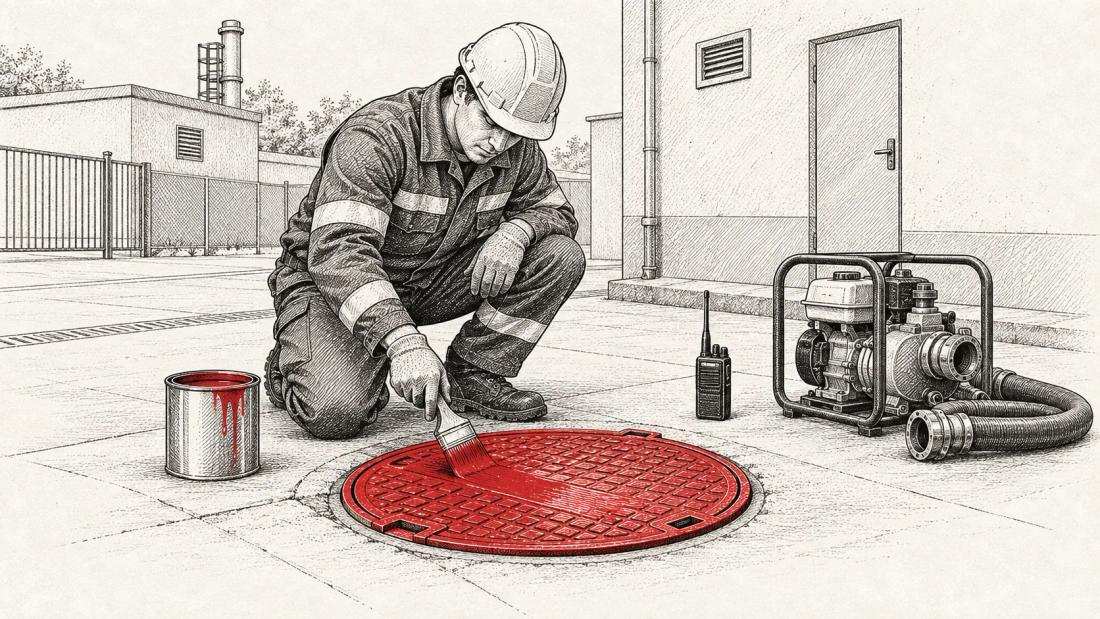
- Paint fire hydrant covers, and the area around them, red. The Fire Safety Rules of Ukraine (Ministry of Internal Affairs Order No. 1417) require markers near fire hydrants and water sources: 3D markers with a light or flat ones with a reflective coating, showing the "ПГ" (fire hydrant) index and the distance to the hydrant. The problem is that the blast wave destroys these markers and can tear off the covers. So fire hydrant covers on your site should be painted a clear red: they're easier to find among debris and in the dark. Don't paint other manholes. Red must mean one thing: "water for firefighting is here."
According to those who have already fought fires at their own sites, only water works. Unfortunately, don't count on anything else.
Step 3. Evacuation routes, light and "patches" for the building
- Staff must know by heart where the obstacles, manholes and utility lines are along evacuation routes. A sign can vanish along with the wall, but knowledge stays in your head.
- Autonomous emergency lighting: rechargeable handheld lamps and flashlights along routes to the shelter. Especially for evening shifts.
- Contractor contacts and a stock of materials: keep OSB or chipboard sheets and heavy plastic sheeting on site in advance, so you can quickly cover blown-out windows and openings and not leave the facility exposed.
- Generator fuel: set a minimum reserve level and decide who is responsible for topping it up. Store reserve fuel away from the main areas and the building, preferably with an earth berm or behind gabions.
Step 4. Communications and air situation monitoring
Early warning. Assign a duty officer to watch the air situation in official channels and monitoring chats. A few extra minutes to reach shelter can be the difference between being injured and not.
Radios instead of mobile phones. During an attack, the mobile network often goes down or gets overloaded. To coordinate evacuation and movement around the site you need a set of working radios: charged, with tested channels and people who know how to use them.
Step 5. Medical: there are never enough tourniquets
Most of your life-saving supplies should be in the shelter, not scattered around the workshops. The workshops get duplicate kits.
From facilities' experience: there are never enough tourniquets and hemostatic bandages. With shrapnel wounds, a person can lose a critical volume of blood within minutes. So:
- increase your stock of quality tourniquets and hemostatics (not the cheapest ones, since lives depend on them);
- keep stretchers, respirators with charcoal filters and gloves in the shelter;
- assign a duty vehicle to the site that can take an injured person to the nearest hospital on its own, without waiting for an ambulance;
- identify employees trained in pre-medical first aid and spread them across shifts.
A reminder: Article 18 of Ukraine's Law "On Occupational Safety" requires employees, at hiring and during employment, to receive training at the employer's expense in first aid for victims and in how to behave in an accident. Today that requirement is anything but a formality.
Step 6. Who does what: the roles matrix
Chaos is the main enemy after an explosion. Roles must be assigned in advance, written down and known to everyone:
| Role | What they do right after the strike |
|---|---|
| Electrician / security / duty manager | Cuts power to the site, shuts off gas (if it's in the heating system) |
| Shelter lead (HQ) | Gathers people, does a roll call by name |
| Employees trained in pre-medical first aid | Give aid to the injured |
| External communications lead | Once the situation stabilizes, officially notifies the State Emergency Service (DSNS) and the police |
| Escort | Meets DSNS and ambulance crews at the entrance and guides them around the site |
The last item is often underestimated. Amid destruction and darkness, rescuers find it very hard to get their bearings on unfamiliar ground. One person at the entrance saves minutes that can cost a life.
And most important: drills. The experience of these facilities is unambiguous: without practice there will be chaos, and people won't know what to do. Even those who have done one or two drills. So drills must be regular, not a box-ticking exercise before an inspection.
Step 7. After the strike: the legal side
It's rarely discussed, but facilities where people were seriously injured or killed ran into the same situation. When police interview staff, they record not only the consequences of the strike but also check whether the employer complied with occupational safety requirements. Violations that led to serious consequences can be classified under Article 271 of the Criminal Code of Ukraine.
Employees in shock may say anything: "nobody trained us," "there were no briefings," "there weren't enough first aid kits." Even if all of that was in place.
What to do about it, honestly and lawfully:
- Have a system in reality, not just on paper. Article 13 of Ukraine's Law "On Occupational Safety" obliges the employer to ensure that an occupational safety management system is in operation. Briefings held, first aid training, evacuation drills, equipment issued: all of it must exist both in real life and in the logbooks. A manager's best defense is real preparation of people that can be backed up with documents.
- Bring in a lawyer. Article 59 of the Constitution of Ukraine guarantees everyone the right to professional legal assistance. A manager or responsible person should bring in a corporate lawyer at the first opportunity for official interviews and statements, in person or at least by phone.
- Don't pressure employees and don't "prepare" their testimony. People have the right to say what they saw. A manager's job is not to control their words but to make sure a real safety system stands behind them.
Also remember: Article 63 of the Constitution of Ukraine allows a person not to testify against themselves or their close relatives. Whether to use that right is something to decide together with a lawyer.
A checklist to run today
- Gas and electrical shutoff points are marked; responsible people and backups are named.
- The instructions state that fire pumps stay powered from the generator.
- You have your own motor pump, hoses and standpipes to the fire water source.
- Fire hydrant covers are painted red, hydrant markers are in place.
- Emergency lighting along routes to the shelter.
- Radios are charged, channels tested.
- The shelter has tourniquets, hemostatics, stretchers, respirators; a duty vehicle is assigned.
- The roles matrix is approved and known to everyone.
- Drills are held regularly, not once a year.
- There is a minimum fuel reserve and someone responsible for it.
- It's clear which lawyer is reachable in case of an incident.
Conclusion
No instruction will make a strike safe. But preparation decides how many people go home after it. Run through the checklist above today, at least the first three items.
If you need help with civil protection, assessing war-related risks or staff training, get in touch. Together we'll set up your preparation so that it works not on paper but in a real situation.

Let’s discuss
your project
Leave your contacts — a RACIO engineer will call and answer your questions.