Occupational Safety in Construction: Where the Risks Are Highest and How to Control Them
Construction safety records more injuries every year than any other sector of Ukraine's economy — which is exactly why occupational safety in construction draws the closest attention from the State Labor Service during both scheduled and unscheduled inspections.
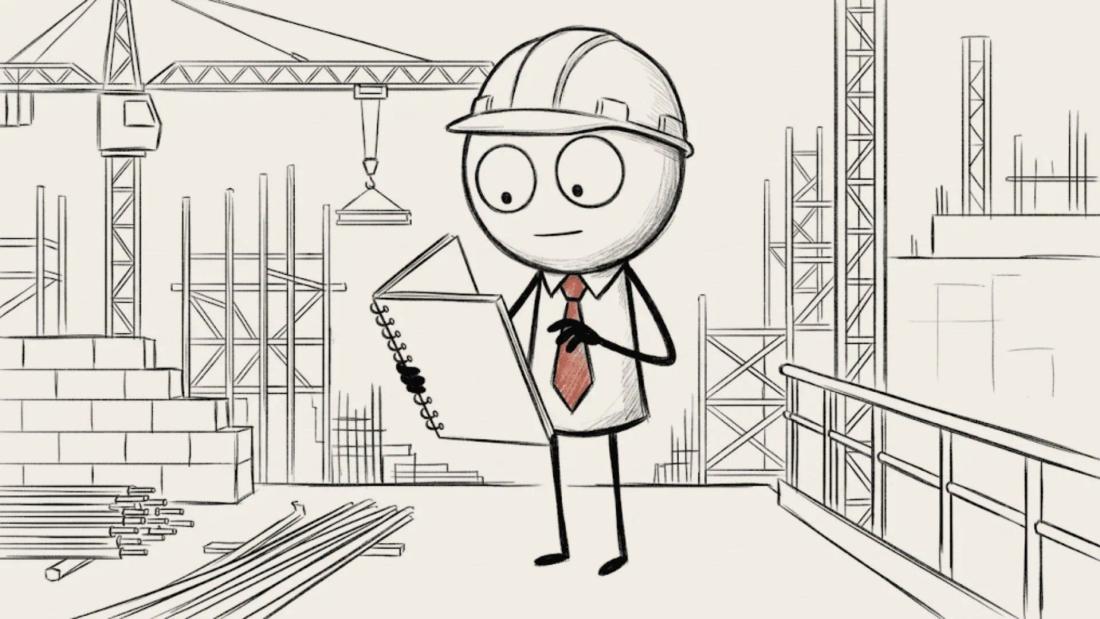
Construction safety records more injuries every year than any other sector of Ukraine's economy — which is exactly why occupational safety in construction draws the closest attention from the State Labor Service during both scheduled and unscheduled inspections. Racio breaks down why construction sites remain a high-risk zone, who exactly is responsible for safety on site, and where to start building a systematic approach if you run a construction company or a single project.
Quick takeaways:
- Construction consistently leads all sectors in workplace injury rates — this isn't a statistical anomaly, but a direct result of constantly changing working conditions on every site.
- Responsibility for safety is split between the general contractor, the occupational safety coordinator, and each subcontractor individually — a gap anywhere in this chain is the typical cause of violations.
- The key risks on a construction site — working at height, permits for high-risk work, power tools, and falling materials — each has its own control procedure.
- On construction sites, the Labor Service most often flags a missing document for a specific type of work, not a total absence of documentation.
- As post-war reconstruction drives construction volumes up in Ukraine, so does the number of inspections targeting companies that still haven't put their occupational safety system in order.
Why occupational safety in construction isn't a formality
A construction site differs from a warehouse or an office in one fundamental way: working conditions change daily, sometimes hourly. Today a crew works at ground level, tomorrow on the floor being built, the day after a crane or a utility trench appears nearby. Each change brings a new set of risks that can't be covered by a single one-time briefing at the start of a project.
That's exactly why occupational safety in construction is its own well-developed field of knowledge, not a section of a general safety manual. The Labor Service understands this as well as builders do: construction sites get inspected more often than offices or retail locations, and fines for violations found there are consistently higher, given the greater risk of severe consequences.
Another factor worth accounting for now: construction volumes are rising as Ukraine rebuilds infrastructure and housing. More sites mean more crews, more subcontractors, and correspondingly more room for gaps in the safety system on any given site.
Regulatory framework: which documents govern construction safety
The foundation is made up of documents common to every industry — the Labor Code and the Law of Ukraine "On Occupational Safety" — but construction is additionally governed by state building codes (DBN), which spell out safety requirements specifically for construction processes: site organization, earthworks, structural assembly, and the operation of lifting equipment.
In practice, this means a two-tier set of documentation: general occupational safety documents that any company should have (orders, regulations, job-specific instructions), and construction-specific ones — a work execution project with an occupational safety section, permits for high-risk work, and documentation for each type of specialized equipment. Skipping the second tier is the most common reason a company technically "has the documents" and an inspection still finds violations.
Who's responsible for safety on a construction site
Responsibility on a construction site is split among several parties, and it's exactly in that split where a gap most often forms unnoticed — until the first incident:
- the general contractor is responsible for the overall safety organization on site and for coordinating everyone involved;
- the occupational safety coordinator — a distinct role, mandatory on sites with several contractors working at once — makes sure one crew's actions don't create a hazard for another;
- each subcontractor is responsible for the safety of its own workers and equipment within its own scope of work;
- the developer (client) retains responsibility for the site's overall condition, even when day-to-day safety management is delegated to the contractor.
The problem arises when every party assumes a given safety issue "isn't their zone of responsibility." A clear division of roles in writing — not just verbally agreed — closes this gap far more reliably than additional briefings ever could.
Key construction site risks and how they're controlled
Occupational safety in construction centers on a handful of risks that repeat across the vast majority of sites regardless of project scale:
- working at height — falls remain one of the leading causes of severe construction injuries; Racio covers the procedure for organizing such work, fall-arrest systems, and scaffolding requirements in a separate piece on occupational safety rules for working at height;
- high-risk work — earthworks, structural assembly, and operating lifting equipment all require a separate permit document; the full step-by-step algorithm for clearing a worker for such work is described in our material on high-risk work;
- work permits — a formal document without which high-risk construction work legally shouldn't begin at all; Racio explains how to properly fill one out in this article;
- power tools and temporary power supply — a construction site is full of extension cords, generators, and hand-held power tools, and this is exactly where safety requirements often get ignored for the sake of speed, a topic Racio has covered in detail separately;
- falling materials and objects — organizing protective barriers, storage zones, and equipment movement routes reduces this risk systematically, rather than case by case.
Personal protective equipment on a construction site
A builder's protective gear kit is considerably broader than a typical office or even warehouse set: a hard hat is mandatory across the entire site, not just in active work zones; steel-toe safety footwear protects against falling objects and punctures; fall-arrest systems are required for any work above the safe height threshold; and high-visibility safety clothing is critical wherever equipment and people move through the same space at the same time. The principles for selecting and tracking personal protective equipment that Racio has covered in detail before apply to construction as well — adjusted for a broader list of mandatory gear.
Clearing contractors and subcontractors to work on site
Construction is an industry where several legally independent companies work on the same site at once: the general contractor, specialized subcontractors for individual scopes of work, and suppliers with one-off access. Every new contractor on site brings a new set of risks that needs assessing before their crew starts work — not after the fact. Racio describes how to build a clearance procedure that doesn't turn into a formality in our article on clearing a contractor to work on site.
Common violations the Labor Service most often finds on construction sites
In practice, inspectors rarely find a complete absence of occupational safety documentation — companies generally understand that's required. What happens far more often: a work permit exists but lacks the actual signature of the person responsible on site; a worker at height has a fall-arrest system, but it hasn't had a current technical inspection; power tools get used without an insulation resistance check; a subcontractor works on site without any briefing from the general contractor, because "they were already briefed at their own company." Each of these violations looks minor on its own, but together they form the real safety picture on a site — and that's exactly what an inspection zeroes in on.
Building an occupational safety system on a construction site: where to start
A company tackling construction safety systematically for the first time should move step by step rather than trying to fix everything at once:
- Audit the current state — assess which documents already exist and which are missing for the specifics of particular sites.
- Put the division of responsibility in writing, between the general contractor, the occupational safety coordinator, and subcontractors.
- Roll out a work permit system for all high-risk work, not just the most obvious cases.
- Equip staff with personal protective equipment matched to the site's actual risks, not just a minimal generic set.
- Set up a clearance procedure for every new contractor — with document checks and an induction briefing before their first day on site.
Why construction companies should order an occupational safety audit
The specifics of construction mean every new site partially resets the safety system from scratch — a new location, often a new lineup of subcontractors, new specific risks. An independent occupational safety and fire safety audit lets you see the real state of affairs before a Labor Service inspector does, and fix the gaps found without a fine.
Racio Consulting Center conducts this kind of audit with construction's specifics in mind: checking not just the general document package, but also the presence of work permits, whether fall-arrest systems are up to date, and the real state of affairs directly on site. For companies without the resources to keep an in-house occupational safety engineer on every site, occupational safety outsourcing is also an option — where a team of specialists supports several construction sites at once under contract. A consultation can be booked online.
Frequently asked questions
Is a separate occupational safety coordinator needed on a small construction site?
This role becomes mandatory when several contractors work on a site at the same time — that's when coordinating their actions with each other becomes necessary. On a site with a single contractor, this function can be combined with the responsible occupational safety engineer's role.
Who's liable if a subcontractor's worker gets injured?
Liability is determined based on whether the subcontractor met its own occupational safety obligations and whether the general contractor provided proper conditions and coordination on site overall — which is exactly why a written division of roles matters so much.
How often should briefings be held on a construction site?
Besides scheduled briefings, construction sites hold an unscheduled briefing whenever working conditions change significantly — a new type of work, new equipment, or a crew moving to a different part of the site.
Does occupational safety differ between residential and industrial construction?
The general principles are the same, but industrial construction more often adds specific risks — working with heavy process equipment, chemicals, or alongside an operating production facility.
Where should a construction company start if it's never approached occupational safety systematically?
With an independent audit of the current state — it immediately shows the priority gaps, instead of guessing where to begin.

Let’s discuss
your project
Leave your contacts — a RACIO engineer will call and answer your questions.