Occupational safety is needed for any business where employment relationships exist — from a small office to a warehouse or a manufacturing site. In simple terms, occupational safety is a set of rules and processes that help you operate without losses, injuries, fines, or work stoppages.
TL;DR
Occupational safety is a system of requirements and actions that ensures safe working conditions and reduces risks for both employees and the employer. For a business, it also means control and clarity: who is responsible for what, which documents are required, how safety briefings are conducted, and what to present during inspections.
What OHS includes:
- risks and operating rules at your sites;
- documentation and appointing responsible persons;
- OHS briefings and staff training;
- compliance control and corrective actions;
- audits and an improvement plan.
Racio breaks it down: what it is, who needs it, what it includes, which minimum documents you need, and where to start — without chaos.
What Occupational Safety Means In Simple Terms
From a legal perspective, occupational safety is defined as a system of legal, socio-economic, organizational and technical, sanitary and hygienic, and preventive measures aimed at preserving an employee’s life and health at work. That’s the “official” definition.
How to explain it in everyday terms? Imagine your business is a kitchen. You can cook fast, but if the knife is dull, the floor is slippery, and the fire extinguisher is “somewhere around,” sooner or later something will go wrong. Occupational safety at a company exists so people follow clear rules instead of “reinventing safety” from scratch every day.
A few simple real-life examples:
- In an office: a properly set up workstation, fire emergency instructions, procedures for business trips and drivers.
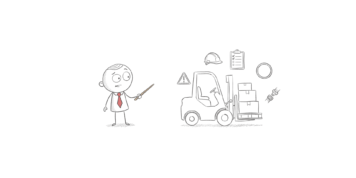
- In a warehouse: forklift operation rules, clear aisles, racking inspections, PPE issuance.
- In a service business: safe tool use, electrical safety, work authorization.
- In manufacturing: training, permits/authorizations, control of hazardous factors, incident investigation.
Occupational safety is exactly what people need when they want a simple answer and a practical plan for meeting requirements.
Who needs occupational safety and when it’s mandatory
The rule is very simple: if you employ people, you need occupational safety. It doesn’t matter whether you have 3 people in a coworking space or 80 employees in a warehouse. The difference is only in scale and risk level.
A quick breakdown by business type:
- Office: usually fewer hazards, but there are fire risks, electricity, evacuation requirements, and computer-based work.
- Warehouse: physical workload, machinery, racking, and on-site vehicle traffic.
- Manufacturing: equipment, chemicals, noise, dust, work at height, and higher-risk operations.
- Drivers: work/rest schedules, medical checks, vehicle condition, and route instructions.
- Remote teams: rules, briefings, and documented proof are still needed — the format is just different.
What occupational safety is built on: the legal framework
To avoid drowning in references, follow a “top-down” logic. OHS regulations consist of several levels, and they work together.
- The Constitution of Ukraine — basic rights to safe working conditions.
- The Labor Code (KZpP) — general labor rules and obligations of both parties.
- The Law “On Occupational Safety and Health” — the core framework for employers and employees.
- NPAOP — sector-specific rules and requirements for particular jobs, equipment, and processes.
- ISO 45001 — an international standard that companies with foreign management often use as a model for a structured OHS system.
In everyday terms: there are general rules of the game, and there are detailed instructions on “how to do it correctly.” These OHS legal acts indicate what documents, training, and control mechanisms your business needs.
Who is responsible for what in occupational safety
Employer (Director): key responsibilities
In Ukrainian practice, the director is responsible for organizing the system. Even if tasks are delegated, responsibility does not disappear. That’s why the “owner told HR to handle it” approach fails if there’s no authority and no time allocated.
What typically falls under OHS organization at management level:
- appoint an OHS responsible person and responsible persons for departments/sites;
- approve rules, instructions, logs, and training procedures;
- organize OHS training and knowledge checks where required;
- ensure employee medical checks as required (depending on job specifics);
- provide PPE and control its proper use;
- respond to incidents and conduct investigations;
- plan and fund safety measures;
- prepare for inspections and comply with official orders;
- implement improvements after audits and incidents.
Department manager: day-to-day actions
A foreman, warehouse supervisor, or shift manager often becomes “the person who keeps things real.” They see how work is done, what is being violated, and where the risks are. Their responsibility includes daily control, initial and refresher briefings, work permits/authorizations, and order at workplaces.
OHS service or specialist: functions and authority
An OHS specialist builds the process as a system: assesses risks, prepares documentation, organizes training, supports inspection readiness, and advises management. In larger companies this is a dedicated team; in smaller ones it may be a single person or an external provider. As a company grows, it’s important not to lag behind — moving from a “folder of documents” to a real working system.
Employee: personal responsibility
Employees must follow rules, use PPE, complete briefings and training, and report hazardous situations. Without their conscious participation, no procedure works — even if documentation is perfect.
HR’s role
HR often manages communication and discipline: ensuring new hires complete onboarding, logs are properly filled out, medical checks aren’t “forgotten,” and training isn’t postponed indefinitely. This isn’t “just paperwork” — it’s process control.
What is included in an Occupational Health & Safety Management System (OHSMS) at a company
In professional terms, you’ll often hear: Occupational Health & Safety Management System. Simply put, it’s “how we manage safety.” You can think of it as a cycle where each step strengthens the next.
An OHS management system follows a clear logic: risks → rules → training → control → improvement. First you identify what can go wrong, then you define the rules, train people, verify compliance, and continuously improve.
It’s important not to mix up the terms. Managing OHS is the management process itself, while the OHS system is the full set of people, documents, and practices that support that process. The employee is always at the center: safe working conditions and the risks that could harm their health. In more academic wording, the subject of OHS is preventing injuries and occupational diseases through organizational (people/process) and technical (equipment) solutions.
The minimum set of OHS documents
This is a key block for HR and the director. When an OHS inspection happens, it’s not just about “having files” — inspectors look for the logic: who is appointed, how you train, how you document activities, and how you control and enforce the policies you’ve introduced.
A simple rule of thumb: OHS documents at a company must match your actual work activities and organizational structure. Below is a minimum set that most SMBs typically need:
- internal orders on OHS organization and appointment of responsible persons;
- an OHS policy/regulation and a process description — who does what;
- OHS instructions by roles and types of work (office, warehouse, manufacturing);
- briefing/training logs and other registers depending on the specifics;
- training programs and knowledge-check records (when required);
- documents for medical checks and PPE provision (depending on work types);
- procedures for incident investigation and hazard reporting.
In everyday language, people may call this “OHS documents” or “OHS documentation.” The meaning is the same: a set of internal rules plus evidence that you actually follow them.
A separate point is developing OHS documentation. This is needed when templates don’t reflect your real risks — for example, a warehouse with forklifts or a production site with machinery.
OHS briefings: types and frequency
Questions about types of OHS briefings are always common, because this is where people get confused most often. The key idea: briefings are not a “one-time talk” — they are ongoing work with documented proof.
The main types of OHS briefings are:
- induction (introductory) briefing — for all new employees, interns, and seconded/visiting staff;
- initial briefing — at the workplace before starting work;
- refresher briefing — on a regular schedule depending on the work type;
- unscheduled briefing — after process changes, incidents, or violations;
- targeted briefing — for a one-off task or high-risk work.
Who conducts them? Induction briefings are typically done by an OHS specialist or HR, while initial and refresher briefings are conducted by the line manager. The “we sent a PDF and that’s it” approach doesn’t work without documented evidence. You need logs or other legally valid proof.
For remote work, the logic is the same: the person must receive the rules, complete the briefings (induction + initial) and a knowledge check — and this must be properly documented.
How to build OHS “without chaos” — a step-by-step plan
The worst-case scenario is doing everything “for yesterday” — when you already receive a document request from the State Labour Service or even the National Police. It’s better to spend a few hours setting a structure and then operate with peace of mind.
A practical sequence that works for most SMBs:
- Initial assessment. What work you do, what sites you have, what risks exist, and what documents you already have.
- Risk matrix. List hazards and control measures. No need for “200 pages” — clarity matters. This step is mostly recommended.
- Documentation. Approve internal orders, instructions, logs, and procedures for training, medical checks, and PPE.
- Training and briefings. Run induction and initial briefings, and set a schedule for refresher briefings.
- Control. Internal site checks, violation analysis, and corrective actions.
- Planned review. Once or twice a year, conduct an OHS audit and identify weak spots.
That’s what practical OHS organization looks like at company level: not just “creating documents,” but implementing a cycle and maintaining it.
How much one incident can cost (an example cost model)
When people say “OHS is expensive,” I usually ask: have you calculated how much a single incident costs? The model below is not a universal truth — it’s a way to feel the order of magnitude and understand the logic.
Example. In a warehouse, an employee twists an ankle because an aisle is cluttered. It seems minor, but the consequences add up:
- a 2-hour downtime for the area while the manager records the case and finds a replacement;
- overtime for another employee or temporary coverage;
- HR time for paperwork, explanations, and communication during incident investigation;
- risk of claims from authorities if it turns out refresher briefings were missing or aisles weren’t controlled.
Sometimes the cost isn’t measured in money, but in a missed shipment, a client conflict, and team stress. That’s why the main goal of OHS is not “to close the paperwork,” but to reduce the likelihood of such situations and make the response predictable.
FAQ
Does a small office need OHS?
Yes. If you employ people, minimum rules are always required. The scope is simply smaller than in manufacturing.
Who can be appointed as the responsible person?
Usually someone with administrative duties or a department manager. The key is real authority and time — not just a signature in an internal order.
Can OHS be organized through outsourcing?
Yes. SMBs often choose OHS outsourcing to avoid keeping an in-house specialist and to reduce disruption from staff turnover. But even with a contractor, you still need responsible people on site.
What documents are required at a minimum?
Orders appointing responsible persons, instructions, logs, a procedure for training and documenting briefings, and medical checks/PPE blocks depending on the work type. These are the basic OHS fundamentals in documentation.
How do you conduct briefings for remote employees?
Online. Provide a remote briefing and a knowledge check, and document completion in any format that can serve as evidence. For remote staff, recording briefings in traditional paper logs is not mandatory. The core requirement is the same: briefings must be real and provable.
How often should you run an audit or internal review?
Typically, an internal review 1–2 times per year is useful, and always after changes in work, sites, or after incidents.
When it’s worth involving a specialist
There are a few triggers when handling it alone becomes difficult and you risk losing time:
- you open a warehouse or production site with higher risks;
- you scale the team and documentation/briefings can’t keep up;
- contractors are involved; there is work at height, electrical work, forklifts, machinery, or chemicals;
- you receive a document request or expect a State Labour inspection;
- an incident happens and you need a proper investigation.
In such cases, OHS expertise and quick diagnostics help. The Racio team starts by assessing your current state and building an action plan: what to fix first, what documents are truly needed, and how to set up briefings and control without overloading your team. You can order an OHS audit from us with a focus on outcomes.
Summary. OHS is not “scary bureaucracy” — it’s a manageable system. When it’s set up properly, business runs calmer: fewer incidents, fewer emergencies, and clear rules for everyone. And then the question “what should we do?” becomes a simple, step-by-step plan.