How to conduct an occupational health and safety training at the workplace?
«Safety is what happens between your ears, not what you hold in your hands» — Jeff Cooper In the previous series of our series on training, your company hired a new employee — provided him with a laptop, stationery, etc. and conducted an introductory occupational safety training.

«Safety is what happens between your ears, not what you hold in your hands»
— Jeff Cooper
In the previous series of our series on training, your company hired a new employee — provided him with a laptop, stationery, etc. and conducted an introductory occupational safety training. In case you missed it, here is a link to the previous series «How to conduct an introductory occupational safety briefing?».
The next stage of any new hire’s initiation is the primary occupational health and safety briefing. How to conduct it, where to record it, what to say, and who should do it — below we will look at the main steps to solve this problem, which will allow you to safely integrate newly hired employees into their work environment.
Step 1
Determine who needs to conduct the primary occupational health and safety briefing.
The correct answer is: everyone who got a job at the company.
More specifically, and in accordance with the law, the following categories of employees need to be briefed on the initial training:
- newly hired (permanently or temporarily);
- those who are transferred from one unit of the enterprise to another;
- those who will perform new work for them;
- seconded employees of another company who are directly involved in the production process at your company.
A separate category includes students, cadets, trainees and students of educational institutions who:
- are doing an internship with you;
- or, as part of an existing internship, receive a new learning task that involves the use of various mechanisms, tools, materials, etc.
Primary training can be conducted with each individual or with a group of people. For example if you hire 1 storekeeper and 22 pickers who will perform similar work in the warehouse, you can conduct this briefing together.
Step 2
Who will conduct the primary training?
And here the first person who comes to mind is an occupational safety engineer. And somewhere in the corner, this engineer is crying because he knows he has no right to do this.
How and who should do this, you may ask? Let’s figure it out…
The legislation states that the primary training is conducted by the immediate supervisor of the work, usually a production manager, warehouse manager, foreman — the person who manages the production process. This person must be appointed by a separate order as a person responsible for labor protection. Each structural unit may have its own responsible person. And as you can see, among the list of all these people, there is no occupational safety engineer, his mission to conduct briefings ended at the introductory training.
Now let’s look at a couple of practical cases.
Let’s imagine a company that has a warehouse and a fairly small production facility.
How do you choose who should conduct training where?
Option 1 — If the company is quite small and does not have separate positions of warehouse manager and production manager because they report directly to the director, the director is responsible for both departments. He or she will personally conduct such a training and put his or her signature in the journal.
Option 2 — If the staffing table includes the positions of heads of such departments — you have a warehouse manager and a production manager — appoint them by order to be responsible for occupational safety in their departments, and, accordingly, for conducting briefings. In this case, the warehouse manager instructs the warehouse staff, the production manager instructs the production staff, and the director can keep the office staff.
Whoever conducts the primary training at the workplace must undergo training at the training center on general occupational safety and health issues and, additionally, on the rules under which his or her subordinates perform work.
For example, if a warehouse manager instructs an employee who will be working on a forklift, he or she must also undergo training at a training center on forklift operation and loading and unloading operations in addition to a general occupational safety course and have the appropriate certificates.
Step 3
Where to hold it?
Unlike the introductory training, you don’t need an occupational health and safety office in this case. Primary training can be conducted directly at the workplace. Important: the primary training at the workplace must be conducted BEFORE your employee starts performing the work assigned to him or her.
Step 4
Conduct the briefing itself.
Training at the workplace is carried out in accordance with occupational safety instructions. Each type of work or profession should have its own instruction. For example, you need to instruct a storekeeper, you should have an instruction for a storekeeper or when working in a warehouse.
What exactly should we talk about during the primary training?
Cover the following during the training:
- general information about the equipment that the employee will use;
- the main hazardous production factors that arise during work and the specifics of their impact on the employee;
- requirements for organizing work and maintaining the workplace;
- PPE and how to use it;
- Preparation for work (checking the serviceability of equipment, starting devices, tools and devices, lockouts, grounding and other protective equipment);
- safe work techniques and methods;
- safety requirements after completion of work;
- typical causes of accidents and occupational injuries;
- actions in case of emergencies, first aid to victims.
At the end of the primary training, the trainer should check the knowledge of the trainee. This can be done verbally, you can develop tests, or you can create a survey system that will count and check the knowledge itself. It’s up to you.
In case of unsatisfactory results of the knowledge test on safe work performance, additional training and a second knowledge test are conducted within 10 days — in practice, this is extremely rare, but…
Step 5
Document the fact of the training.
To do this, we need a Workplace Training Registration Log.
When filling out the log, pay attention to what is indicated in the table header — and fill it out in accordance with the requirements there.
Please note that column 5 should include all instructions under which the training was conducted. Successfully tested knowledge is recorded in column 12 of this log. The manager signs twice — in columns 9 and 12, and the employee at the stage of primary training only in column 8.
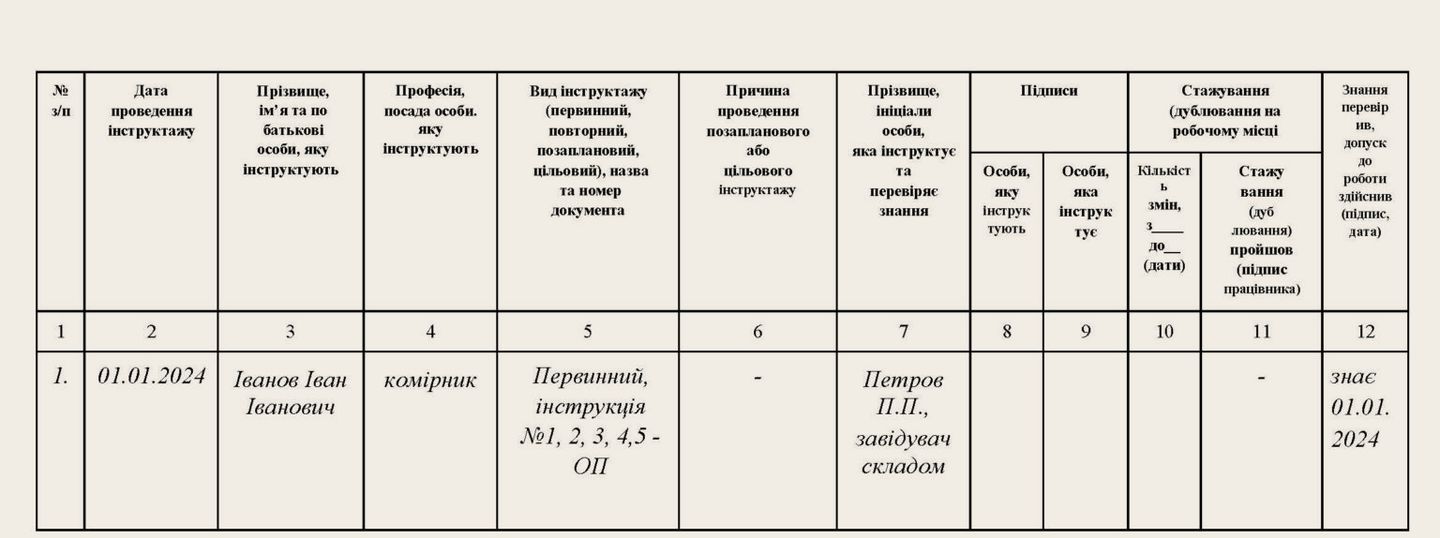
Well, as you all know, the pages of the training registration log must be numbered, laced and stamped.
How to conduct an primary training session with employees who work remotely?
There are two options here:
First, if your employee does not use your company’s equipment, you do not need to conduct such a training.
Second, if you have given something to an employee, here is a step-by-step algorithm on how to conduct a labor protection briefing for an employee remotely:
- In the regulation on electronic document management (you must have such a document if your company has implemented electronic document management), describe in several paragraphs the procedure for signing occupational health and safety documentation.
- We draw up an employment contract that sets out the format of remote work.
- We approve the format of training and document exchange by order.
- We conduct training online.
- We exchange documents in accordance with paragraphs 1 and 3.
- Importantly, your electronic documents should be stored in the same way as paper documents. This does not mean that you have to print them, but rather that they should be stored in the cloud, on an email server, or on a local computer. The retention period for paper documents is 10 years, so we can assume that digital evidence of your briefing should be kept for the same period of time, and this point should also be described in the regulation on electronic document management in the company. Bad news or not, it’s not clear what these documents should look like exactly.Therefore, until a specific format is established, we will use the established form of a paper register, according to (Annex 6) of the Model Regulations.
If you thought that was all, no…
After induction, newly hired employees performing high-risk work (e.g. welders, crane operators, etc.) must undergo an internship for at least 2-15 shifts or a backup for at least six shifts under the supervision of experienced, qualified employees before starting independent work.
We will discuss this in more detail in our next article….

Let’s discuss
your project
Leave your contacts — a RACIO engineer will call and answer your questions.