Occupational safety briefings are not a formality — they are a basic tool for preventing workplace injuries, accidents, and emergencies. For a business, they are also part of legal protection: proper briefing management helps demonstrate that the employer fulfilled their duty to provide safe working conditions. This article explains how primary, refresher, unscheduled, and targeted briefings differ, when they must be conducted, who is responsible, and how to document everything properly.
What occupational safety briefings are and why they matter
An occupational safety briefing is a form of training that teaches employees safety rules while performing their job duties. Its main purpose is to inform an employee about workplace risks, teach safe working methods, and explain actions in case of accidents or emergencies. In Ukraine, the procedure for conducting briefings is regulated by Order of the State Mining Supervision Authority No. 15 dated 26.01.2005, other sectoral regulations, and the company’s internal policies. Briefings are mandatory for all employees — both newcomers and experienced staff. They must be conducted before starting work, periodically, and also under certain circumstances (technology changes, incidents, etc.). The employer is responsible for organizing the process, while the direct briefing is typically delivered by a department supervisor or an OHS responsible person. Briefings are recorded in the occupational safety briefing log with the date, topic, and signatures of the instructor and the employee.Key differences between briefing types
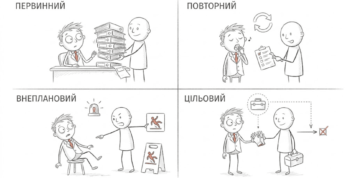
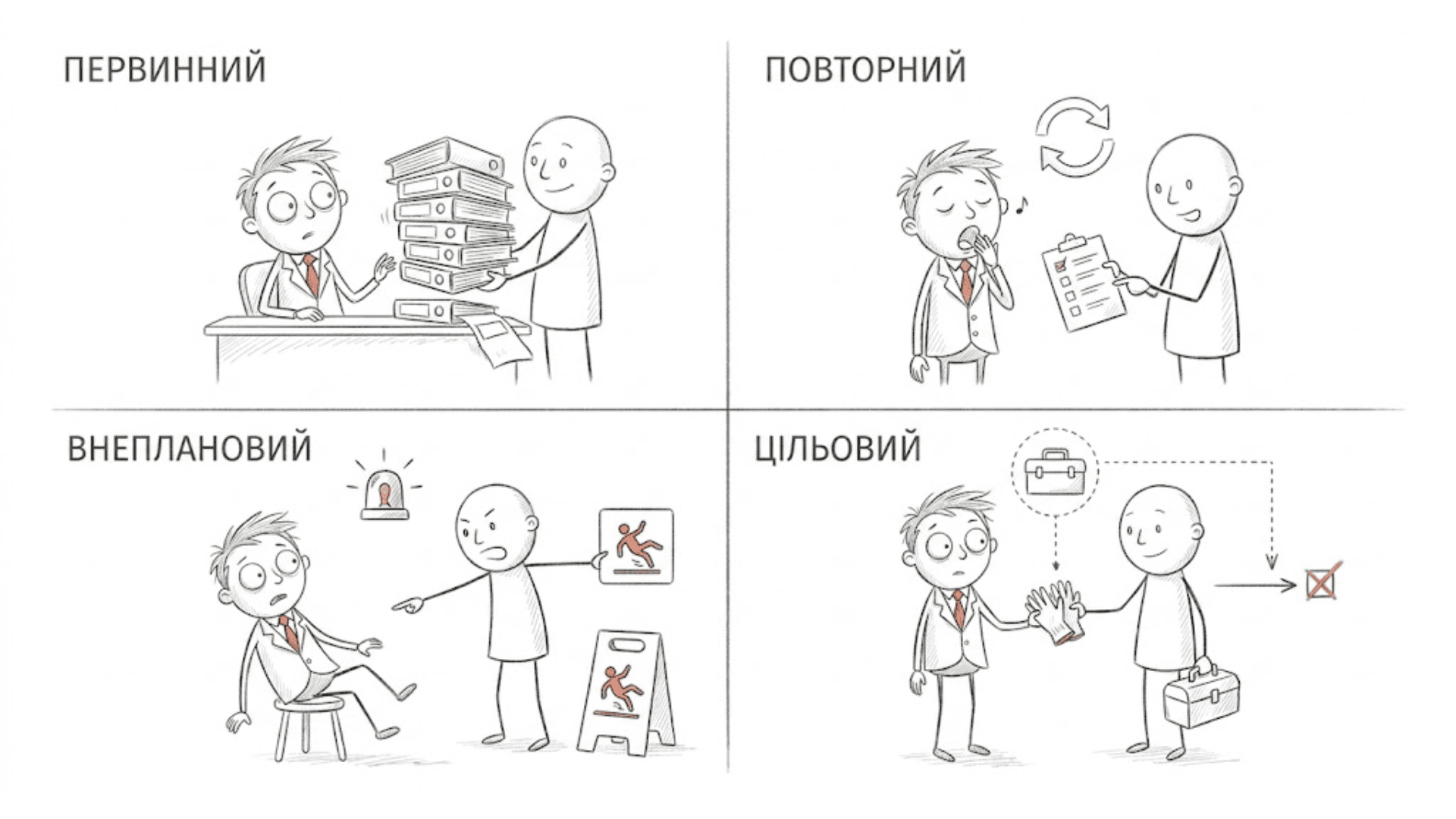
All types of occupational safety briefings share one goal: building safe behavior at the workplace. However, each type is delivered at different times, to different employee groups, and with a different scope of information. For easy navigation, here is a concise comparison table:| Briefing type | When conducted | For whom | Where conducted | Conducted by | Documentation | Frequency |
| Primary | Before starting work or internship | New hires, transferred staff, trainees | Directly at the workplace | Supervisor or OHS specialist | Briefing log + employee signature | Once before work starts |
| Refresher | Regularly, per schedule | All employees | At the workplace | Supervisor/instructor | Log + knowledge check (if needed) | Every 3 or 6 months |
| Unscheduled | After changes in work/regulations, incidents | Everyone affected | Workplace or office | OHS specialist/supervisor | Briefing log | As needed |
| Targeted | Before one-time/high-risk tasks | Selected employees | Before the work location | Person in charge of the task | Log or work permit | Each time before the task |
Primary briefing
3.1. When it is conducted
A primary briefing is conducted before an employee starts performing job duties. It is required for:- newly hired employees (including temporary and seasonal staff);
- employees transferred to a new position or a different workplace;
- pupils, students, and trainees completing an internship or practical training.
3.2. Where and who conducts it
The briefing is conducted directly at the workplace before work begins. It is delivered by the department manager, foreman, or another person appointed by an internal order. If the company has an OHS service, it develops the programs, but it does not deliver the primary workplace briefing itself.3.3. Program and documentation
The primary briefing program must include:- a description of the workplace and working conditions;
- analysis of hazardous and harmful factors;
- rules for safe use of equipment;
- actions in case of accidents, fire, or injuries;
- location of the first-aid kit, fire extinguisher, and evacuation routes.
Refresher briefing
4.1. Frequency
A refresher briefing is conducted regularly, regardless of the employee’s experience. Its goal is to renew OHS knowledge, remind employees about risks, and reflect changes in processes, regulations, or working conditions. Standard frequency depends on the nature of work:- once every 3 months — for employees performing high-risk work;
- once every 6 months — for other production staff.
4.2. Scope and knowledge check format
A refresher briefing covers a concise review of the main instructions specific to the workplace. After completion, an oral or written knowledge check is conducted. In some cases, a practical demonstration of actions in a potentially hazardous situation is required. Results are recorded in the occupational safety briefing log, including the date, relevant instructions, employee name, and signatures of the instructor and the trained employee.4.3. Typical mistakes
Common violations related to refresher briefings include:- no entries in the log — the briefing was “done” but not documented;
- no knowledge check — the employee signed without actually learning;
- missed deadlines — the briefing was not conducted on time;
- the same date for all employees — a sign of a formal approach;
- missing signatures or incorrect completion of log fields.
Unscheduled briefing
5.1. Grounds for conducting
An unscheduled briefing is not done according to a schedule. It is conducted when knowledge must be updated due to changes in working conditions or legislation. Typical grounds include:- amendments to occupational safety legal acts;
- introduction of new equipment, materials, technologies, or changes in the technological process;
- accidents, injuries, emergencies (at the company or similar facilities);
- a long break in work (over 30 calendar days for high-risk work, over 60 for low-risk work);
- orders from supervisory authorities or recommendations from OHS commissions or medical services.
5.2. How to document and who initiates it
The initiator is usually the OHS responsible person or the head of the unit. The briefing may be individual or group-based, with a mandatory entry in the occupational safety briefing log. In the “grounds” field, a specific reason is stated: “instruction updated”, “new equipment”, “emergency”, “labor inspection order”, etc. Sometimes an unscheduled briefing act/report is prepared when changes are large-scale or when detailed documentation is required.Targeted briefing
6.1. One-time tasks: high-risk work, emergency response, work permit
A targeted briefing is conducted before one-time or non-routine tasks associated with increased risk. This includes:- high-risk work (e.g., work at height, confined spaces, use of explosive substances, etc.);
- emergency response and elimination of consequences of natural disasters or other extraordinary events;
- temporary assignment to work outside the employee’s standard duties;
- work performed under a work permit (electrical safety, fire safety, gas-hazard work, etc.).
6.2. Content and responsible persons; links to fire/electrical safety
The content depends on the task and typically includes:- assessment of potential risks;
- safety measures;
- personal protective equipment (PPE);
- emergency action plan;
- list of responsible persons;
- permit-to-work briefing (if applicable).
Documents and records: what you must have
Proper documentation of occupational safety briefings is not just a formality — it is also legal protection for the employer in case of inspections or accidents. All types of briefings must be officially recorded in accordance with applicable legal requirements. Key documents that must be available:- an order (policy) on organizing OHS training and briefings at the company;
- briefing programs for each type (induction, primary, refresher, etc.);
- occupational safety instructions by job role and type of work;
- an OHS briefing log/register with clearly defined fields:
- date of briefing;
- briefing topic;
- employee full name;
- position;
- signatures of the employee and the instructor.
Templates and a manager checklist
To ensure briefings are delivered on time and correctly, a department manager or OHS responsible person should have a clear set of documents and a step-by-step action plan. This helps prevent violations, keep control of the process, and stay prepared for inspections. Useful templates and samples:- sample order on organizing OHS briefings;
- sample OHS briefing log/register (digital or paper);
- example program for primary/refresher briefing;
- knowledge check act form after a briefing;
- permit-to-work template for targeted briefings;
- manager checklist for conducting briefings.
- Determine the briefing type and the grounds for conducting it.
- Prepare the program and up-to-date instructions.
- Conduct the briefing personally or delegate it to an authorized person.
- Ensure the employee understands the briefing content.
- Record it in the log (or in an act).
- If required — check knowledge or clearance to work.
Conclusions
Occupational safety briefings are not bureaucratic paperwork — they are a real risk management tool. Their quality affects not only employee safety but also the company’s reputation, financial stability, and legal protection. Remember: each briefing type has its own purpose, conditions, responsible person, and documentation. Only a systematic approach allows you to:- avoid fines and violations;
- reduce workplace accidents;
- improve employee safety awareness.