
In September 2025, the Ministry of Health of Ukraine approved Order No. 1393, which finally introduced a new “Procedure for Organizing and Conducting Mandatory Medical Examinations.” The old and familiar Order No. 246 from 2007 has officially become history.
The declared purpose of the changes sounds appealing: European integration, prevention, and quality supervision. But is everything really that simple in practice?
Let’s take a closer look at what employers, occupational safety engineers, and HR specialists should now prepare for.
Key Changes
1. New categories of employees subject to mandatory medical examinations
In addition to the traditional categories — employees working in hazardous or harmful conditions and employees under the age of 21 — the following have been added:
- Employees working on a shift schedule involving night work (Section I, clause 2.4).
- Employees exposed to carcinogens, mutagens, and/or biological agents.
As a result, under the new procedure, there are now four categories of employees subject to mandatory medical examinations:
Employees engaged in hazardous and dangerous occupations, including exposure to mutagens;
Employees who require professional selection;
All employees under the age of 21 (regardless of working conditions);
Night shift employees.
Notably, drivers are not mentioned at all in the new Procedure. Moreover, the State Labor Service itself has not yet clarified how drivers should be classified — whether under professional selection or another regulatory act.
An additional reason for unscheduled medical examinations.
A new ground for conducting an extraordinary (unscheduled) medical examination has been introduced — at the request of the State Labor Service.
How this will be implemented in practice remains unclear at the time of publication.
2. A Fundamental Shift in Philosophy: From “Fit for Work” to “Dynamic Monitoring”.
The core purpose of medical examinations has changed:
- Old approach:The main goal was essentially to obtain a “stamp of approval” — a certificate confirming the employee’s fitness to perform certain work.
- New approach: The goal is dynamic monitoring. Physicians are expected not only to assess current fitness, but also to analyze the long-term impact of work on an employee’s health.
This shift is also reflected in documentation, although wording related to fitness for work still remains in referrals.
3. A New Control Tool: Dynamic Monitoring Groups (DMG).
To support the new philosophy, a clear classification of employees into Dynamic Monitoring Groups has been introduced to ensure continuous medical supervision.
The assigned group is indicated in the Employee Medical Card / Medical Certificate subject to mandatory medical examination.
| Groups | Criteria | Monitoring |
| DMG-1 | Employees with 10 or more years of professional experience in harmful or dangerous working conditions, with no general diseases. | Supervised by an occupational pathologist of the Commission.
|
| DMG-2 | Employees diagnosed with general (non-occupational) diseases during a medical examination. | Supervised by the physician with whom the employee has a signed declaration. (The practical implementation of this supervision mechanism is still unclear.) |
| DMG-3 | Employees with diagnosed occupational diseases, disability due to general diseases, or those with detected signs or suspicion of an occupational disease. | Referred to a regional or city occupational pathologist and, if necessary, to specialized institutions to establish a final diagnosis and its link to occupational exposure. |
So, the general requirements for each type of medical examination are:
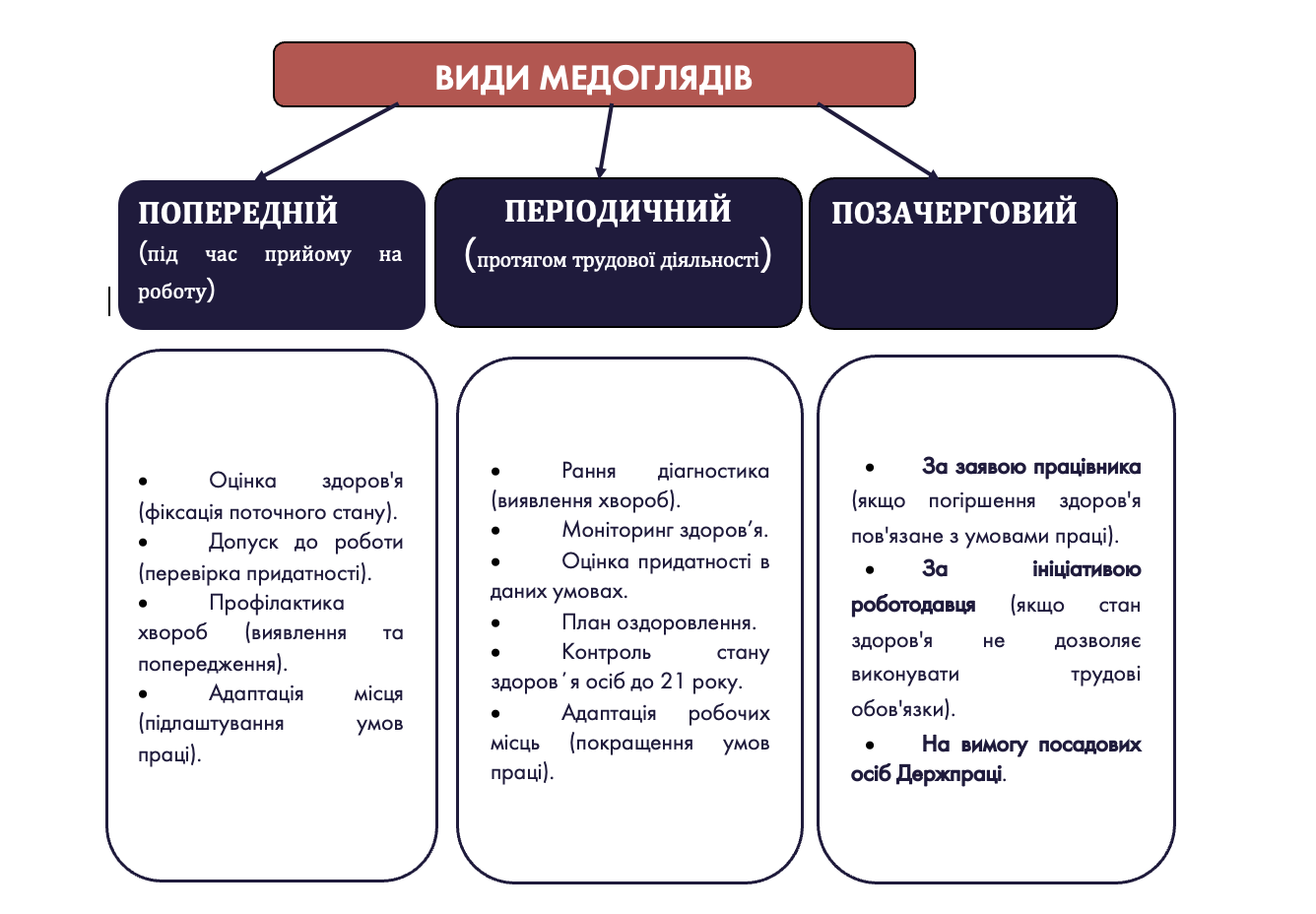
4. Stricter Requirements for Medical Commissions.
Order No. 1393 significantly tightens requirements for medical institutions conducting mandatory medical examinations (now officially abbreviated as MME, instead of the previously used “ME”).
Only medical institutions that:
- Provide specialized services in Occupational Pathology;
- Have their own laboratory, X-ray, and functional diagnostics;
- Have a Commission headed by an occupational pathologist (not just a general practitioner), are eligible to conduct examinations.
5. Detailed Medical Examinations.
The list of required laboratory and functional tests (Appendices 4 and 5) remains largely unchanged, though some types of work have been added. Preliminary examinations require chest X-rays (frontal view). Periodic examinations require fluorography.
Preliminary Medical Examination:
This process consists of five steps.
Step 1 — Informing the employee
Before the start of work under an employment contract (except for employees who work remotely), the employer is obliged to inform the employee, against signature, about the presence of hazardous and harmful production factors at their workplace, the employee’s rights to benefits and compensation for working in such conditions in accordance with the law and the collective agreement, and even the genetic consequences for descendants (it is not known how exactly the employer should investigate such an impact).
Step 2 — Choosing a medical institution. The employer concludes a contract with a medical institution that has a duly established Commission.
Step 3 — Appointing a responsible person. The employer appoints responsible persons (with involvement of the OSH service) to organize and oversee MMEs.
Step 4 — Issuing a referral. Fill out the referral form in accordance with Appendix 3. Everything here is standard: fill in your full name, position, date of birth, and the items that need to be checked by the OMO. Where can you find these items? Refer to Appendix 4 and Appendix 5 to the Procedure, which list the types of work or harmful or hazardous production factors and factors of the labor process that require a preliminary (periodic) medical examination of employees. Please note that there are two new columns: passport details and work experience in the chosen profession.
What about persons under the age of 21, you may ask? Fill in everything by analogy: if there are items according to Appendix 4 and Appendix 5, indicate them in the referral; if there are none, leave the field blank.
Resume:
- The fields “Passport details” and “Work experience” have been added.
- Who issues it: now this can be officially done by a representative of the HR department (congratulations on your new responsibility!).
- Where to find the factors: See Appendices 4 and 5 to the Procedure. For young people under 21, fill in by analogy: if there are factors, write them down; if there are none, leave them blank.
Step 5 — Medical examination.
The employee must provide:
- a copy of your passport;
- the original or a copy of your Employee Card, which is subject to OMO. If you do not have such a card, it will be issued by the medical institution conducting the OMO. The form of the employee card is set out in Appendix 7 to this Procedure.
- a referral for a preliminary medical examination in accordance with the new procedure. Download a sample.
- Employees engaged in high-risk work and those requiring professional selection shall additionally provide the commission with the conclusion of a psychophysiological examination.
Certificates from a narcologist or psychiatrist are not equivalent to a psychophysiological examination.
After periodic examinations, the employee receives Form No. 025-9/o and must submit it to their family doctor. The employer receives the referral with information on fitness for work.
Periodic Medical Examination.
Employer responsibility increases significantly.
Step 1 – Appoint a person in charge. As with the preliminary medical examination, we need to appoint a person in charge of organizing the medical examination. This can be one person who will be responsible for all types of medical examinations. Who could this be? Someone from HR, an occupational safety engineer, anyone — the law does not limit this list. What should this person do? Select a medical facility where medical examinations will be conducted and conclude a contract on behalf of the company, then follow steps 2, 3, 4, and 5 below.
Step 2 – Approve the list of categories of employees subject to OMO.
By December 1 of the current year, it is necessary to compile and, within a month, approve with the occupational health doctor of the territorial body of the State Labor Service a list of categories of employees subject to OMO.
To do this, we submit the following package of documents to the State Labor Service:
- Application. A sample application form can be downloaded.
- Staffing table.
- List of employee categories (in accordance with the form in Appendix 1 to the Procedure).
- Reports on laboratory studies of working conditions identifying harmful and hazardous factors in the working environment, and the severity and intensity of the work process (ARM reports).
- Working conditions cards (if necessary) (it is not specified who determines such necessity).
- List of jobs for which preliminary (periodic) medical examination of employees is mandatory (listed in Appendix 5 of the new Procedure).
- List of positions where employees have a shift work schedule that involves night work.
- List of positions where persons under the age of 21 are involved.
How long does it take to approve the list of categories of employees subject to OMO? One month. No more, no less.
The employer informs the employee about the inclusion of his profession (position) in the List in paper or electronic form, in person or by mail upon hiring and/or no later than 10 working days from the date of approval of the List by the State Labor Service.
Step 3 – We approve the lists.
After agreeing on the list from the previous paragraph, the employer compiles a list of employees by name in accordance with the company’s staffing table and the list agreed upon by the State Labor Service.
Lists of employees are compiled in four copies::
- the first – for the employer;
- the second – for the medical institution with which the contract was concluded;
- the third – for the territorial body of the Pension Fund of Ukraine;
- the fourth – for the primary trade union organization of the enterprise, institution, and organization or representative of the labor collective (upon request).
All four copies are submitted to the State Labor Service together with the application form. Then we wait one month for their approval. Again? Again.
Step 4 – Undergo a medical examination.
According to the schedule drawn up by the medical institution, employees begin to undergo medical examinations. Based on the results, the medical institution prepares six copies of the final report (in accordance with the form in Appendix 8 to the Procedure).
For new employees: If an employee was hired this year and underwent a medical examination upon admission, there is no need to re-examine them. This medical examination is valid for up to 9 months.
Regarding transfer to hazardous work: If you are transferring a person from normal conditions to hazardous ones, be sure to notify them in writing and refer them for a new medical examination before they start work.
Step 5 – We agree on the final Act with the State Labor Service.
For approval, we send an application to the State Labor Service in the form with the following list of documents:
- final reports in 6 copies;
- information on the implementation of remedial measures specified in the previous Final Report;
- information on the difference in the number of employees specified in the lists of employees subject to periodic medical examinations and in the Final Report (if necessary).
After that, the approved copies are sent to:
- the first – to a medical institution;
- the second – to the employer;
- the third — to the trade union organization at the employee’s place of work;
- the fourth — to the territorial body of the State Labor Service;
- the fifth — to the CCPH (centers for disease control and prevention under the jurisdiction of the Ministry of Health) of the relevant administrative-territorial unit;
- the sixth — to the territorial body of the Pension Fund of Ukraine.
The retention period for the Final Act is 45 years from the date of its compilation. Previously, it was 5 years.
Therefore, many questions remain unanswered regarding the new procedure.
Which ones exactly?
Order No. 1393 is no longer just a cosmetic overhaul of the old system, but an attempt at a complete restructuring. On the one hand, we see the right vector towards “European integration” and a shift in focus from paperwork to the actual health of employees through dynamic monitoring. On the other hand, businesses have been hit with a new wave of bureaucracy: independent list compilation, multi-stage approvals, and stacks of documents that must be stored for nearly half a century.
The system has become more complex, and the responsibility for organizing the process has fallen squarely on the shoulders of employers and HR departments. In addition, there are still many “gray areas.”
If you need a reliable guide through the chaos of modern occupational safety regulations, we, the RACIO. team, will be happy to help you cope with any difficulties.