«Theory is when everything is known, but nothing works.
Practice is when everything works, but no one knows why.
We combine theory and practice: nothing works… and no one knows why!»
Albert Einstein
We continue to tell you how to conduct occupational health and safety training easily, affordably, without pain and tears. We have already analyzed in detail the 4 main types of occupational health and safety trainings, and the final episode of our blockbuster is now available.
Let`s go…..Scene two after the titles – Pre-job training on labor protection.
To begin with, let’s go with the classics and figure out when objective training is necessary and what it is.
The legislation does not define what targeted training is. Typical Regulations on the Procedure for Conducting Training and Testing of Knowledge on Occupational Safety and Health, only says that it is carried out in the following two cases:
- in the event of an accident or natural disaster;
when carrying out work for which a special permit, order or instruction is issued.
Taking this into account, we can independently conclude that pre-job training is a type of training that is conducted before performing some specific work for some specific purpose.
In the first case, this «specificity» happened somehow by itself (a hurricane hit, a shahed fell, Godzilla attacked), while in the second case, we as a company understand that the work we have planned requires special attention.
Let’s take a closer look at each point separately.
Case 1 – accidents and natural disasters.
Let’s take an unfortunately relevant example. The pieces of Shahed fell on the company and damaged one of the buildings. It is necessary to involve employees in the rubble removal. Since the company has never performed such work before, it does not have the appropriate labor protection instructions. And since the company does not plan to have mines falling on it with any frequency, it does not plan to develop instructions either. We have a situation where work needs to be done in specific conditions here and now. In this case, all those who will be involved in the liquidation must undergo pre-job training.
Who is supposed to tell whom and what?
As with the previous trainings, the pre-job training is conducted by the work supervisor before the start of work. This can be a director, foreman, senior foreman, etc. As a rule, this is the same official who conducts other trainings at the workplace. Important: this list again does not include the occupational safety and health engineer, as he is not the work supervisor.
After identifying all the participants in the training, we choose the place where the training will be held. The main criterion when choosing a location for a pre-job training is safety. There are no other requirements.
What exactly do we instruct about?
Since any accident or disaster is a random and unexpected situation, we do not have any prepared instructions for it. The content and structure of the training will be based on the logic of the work performed in the circumstances. In other words, we independently assess the risks and include methods of preventing them in our training.
Then we enter everything that we have told you in the Workplace Training Log.
In the log, we write down specifically and item by item what we were told, for example, “wear such and such PPE”, “do not touch explosive objects”, etc. It’s more or less clear.
Let’s move on to the next no less interesting case.
Case 2 – special permit, orders or instructions…
For example, your company, Romashka LLC, performs lighting installation work on the customer’s premises. For such work, you need to issue a special permit. We have analyzed in detail all the issues related to the training and admission of personnel in our article Contractor’s access to the enterprise: how to insure against surprises, so that’s not what we’re talking about here. Let’s pretend that everything is great here, just like the book says.
So, before starting work, all your employees who are sent to the customer’s territory must undergo a pre-job training session. It should be noted right away that there is no specific approved list of works for which pre-job training is required. But everyone who is listed in the work permit must undergo such a training.
Who should conduct such training?
As with the primary and repeated training, a pre-job training is conducted by the work supervisor (shift supervisor, team leader, master, etc.) before the start of the work.
When we have decided on all the people involved in the case, we choose a cozy place where the information will be better absorbed. Unlike the previous option, everything is simpler here and it can be a conference room or the direct place where the work will be performed, both on the territory of your company and on the territory of the customer.
Let’s move on to the training itself. Here, you can use both specific training programs and individual occupational safety and health instructions, flow charts, plans, etc. The main thing during the pre-job training is to tell about the peculiarities of the enterprise where the work will be performed, equipment, aura, requirements for the use of PPE, etc.
Next, document the fact of the training.
In this case, you will NOT need a training log. Information about the training is recorded directly in the form of the access special permit. At the same time, it is NOT necessary to record the fact of the training separately in the log.
Read our next article on how to issue a special permit in our next article.
If the work is performed under an order or instruction rather than a special work permit, enter the information in the Workplace Training Log.
What kind of works are these, you may ask?
For example, a company plans to take part in an environmental campaign and plant trees on its premises during business hours. This is something new and not at all related to Classifier of economic activities. Accordingly, before performing such work, it is necessary to conduct a pre-job training session to inform employees about safety requirements when performing work that is not covered by their job responsibilities.
That should have been all, but we still have one final step to take – documenting it.
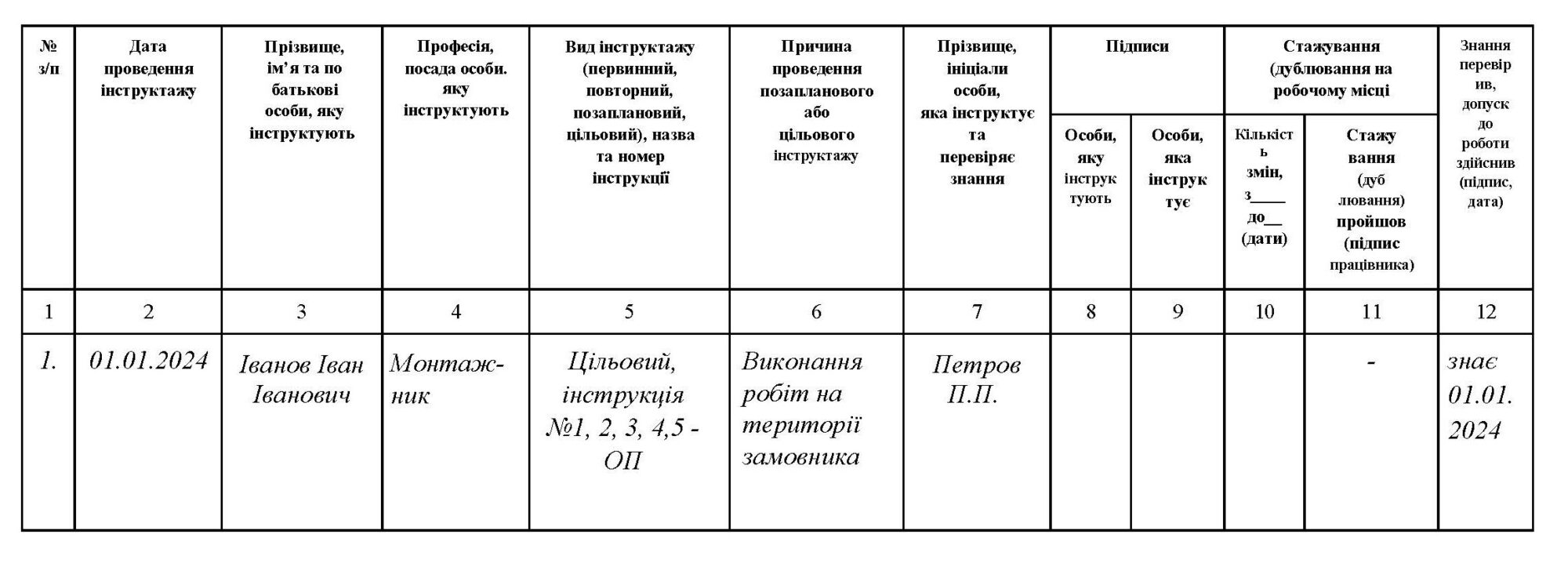
To do this, you will need the well-known Workplace Training Log.
When filling out the logbook, pay attention to what is indicated in the table header – and fill it out in accordance with the text there.
Please note that column 5 must contain all the names and numbers of the instructions and documents under which the training was conducted.
As with unscheduled training, column 6 additionally indicates the reason for the pre-job training. This may be to perform one-time work, to eliminate accidents, or for any other important reason. Like any other training, pre-job trainings are not an exception and end with a knowledge test.
The manager who conducted the training signs twice – in columns 9 and 12, and the employee signs only in column 8. If an employee fails the knowledge test, he or she has 10 days to retake it. If the second attempt is unsuccessful, the employee cannot be allowed to work.
Congratulations, that’s all… Together we have successfully passed all possible and impossible stages of conducting occupational safety and health training. We are waiting for you in our next, no less exciting and useful articles. If you have any questions, you know who to contact.