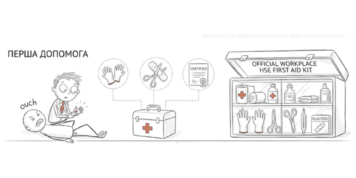
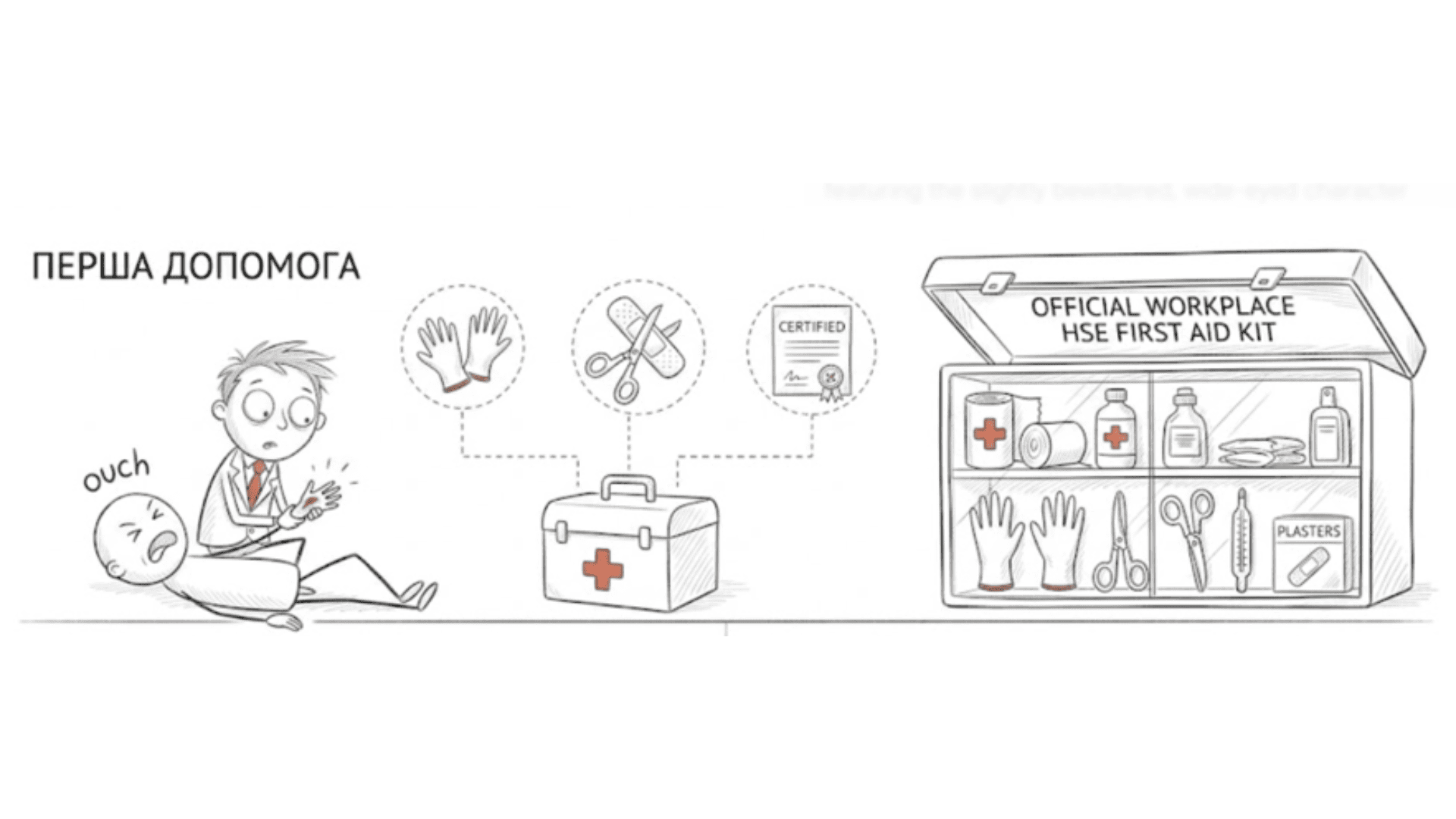
What is first aid, and why is it critically important specifically at work? The answer is simple: in an emergency, the first minutes are decisive. This is the moment that determines whether an injured person can hold on until medical professionals arrive.
At a company site, an emergency can happen anywhere: in a workshop, a warehouse, an office, or even a corridor. Providing first aid before the ambulance arrives often affects the outcome — reducing blood loss, preventing shock, maintaining breathing, and saving lives.
That’s why a workplace first-aid kit is not just a box of bandages. It is a mandatory element of the occupational safety system and, at the same time, an important legal safeguard.
Why first aid is needed at a company
Even if all safety requirements are met, it is impossible to fully eliminate the risk of injuries or sudden health deterioration. From cuts and burns to heart attacks or strokes.
Providing first aid within the first 10 minutes (often referred to as the “golden hour”) significantly increases survival and recovery chances. That’s why fast access to a first-aid kit and trained employee actions are critical.
Benefits of a well-organized first-aid system:
- reduced injury severity and consequences;
- faster stabilization before emergency services arrive;
- increased employee trust in the OHS system;
- compliance with Ukrainian legal requirements (Law “On Occupational Safety”, Art. 13; Labor Code Art. 159; building norms; MoH orders).
Having a universal first-aid medical kit is mandatory for every company, regardless of size, headcount, or industry.
Who is responsible for first aid
Organizing first-aid provision is a shared responsibility, but key roles are clearly defined.
Key roles and responsibilities:
| Role/Function | Responsibilities |
| Owner / Director | Providing conditions, supplying kits, approving policies and instructions |
| HR / People Ops | Informing new employees, including first aid in onboarding programs |
| OHS Specialist / EHS / Fire Safety | Appointing responsible persons, organizing training, checking kits, keeping logs |
| Duty staff / Foremen / Shift leaders | Responding to emergencies, providing aid, calling medics, recording incidents |
| Authorized site persons | Ensuring kit availability, keeping contents up to date, maintaining documentation |
Required documentation:
- order appointing responsible persons;
- first-aid procedure/policy;
- employee instructions;
- list of trained authorized persons;
- first-aid kit inspection log;
- first-aid kit location maps for the site.
Regular first-aid briefings and drills are recommended, including practice for bleeding control, breathing arrest, and similar scenarios.
Workplace first-aid kit: basic contents
For first aid to be effective, the kit must include truly useful items that help stop bleeding, treat wounds, support breathing, or protect the injured person until medical professionals arrive.
Important: a universal workplace first-aid kit should not contain prescription medicines or injectable drugs if there is no medical professional on site. This is defined by MoH requirements and occupational safety standards.
3.1. Protection and hygiene items
These items protect the responder from possible infection (especially when dealing with blood or bodily fluids).
- sterile disposable gloves (2–3 pairs);
- medical masks (2 pcs);
- hand antiseptic (70% alcohol-based gel or spray);
- antiseptic wipes (10 pcs).
Hands should be clean before providing aid, even if they “don’t look dirty.”
3.2. Dressing materials
For wound treatment, covering damaged skin areas, and securing dressings.
- sterile bandages (5–7 pcs in different widths);
- gauze pads (10–15 pcs);
- elastic bandage (1–2 pcs) — for sprains and support;
- adhesive plasters (roll tape and individually wrapped plasters).
3.3. Bleeding and trauma items
This set helps stop severe bleeding and partially immobilize limbs until the ambulance arrives.
- tourniquet — preferably a modern type (e.g., CAT);
- hemostatic gauze/pads or bandages (if available);
- splints or limb immobilizers (can be replaced with rigid cardboard + bandage).
A correctly applied tourniquet or pressure dressing can save a life in arterial bleeding.
3.4. Additional items
Support for vital functions, comfort, and clear guidance in an emergency.
- thermal blanket (isothermal foil) — helps preserve heat in shock conditions;
- blunt-tip medical scissors (for cutting clothing);
- sterile tweezers — for removing foreign objects;
- CPR and first-aid instruction sheet — short, with illustrations;
- emergency contact card (103, 112, internal security, duty officer).
3.5. What NOT to include without medical approval
A common mistake is adding medicines without a prescription — this can be dangerous and may violate requirements.
Do not include without approval:
- Analgin, Citramon, Aspirin;
- “heart” drugs (Nitroglycerin, Corvalol);
- antibiotics;
- injectable medications;
- eye drops, ointments.
Any medication used without a doctor’s prescription may cause allergies, anaphylaxis, or worsen the condition. Even a “simple pill” can lead to legal claims against the employer.
Recommendation: each company can create an approved list of medicines allowed in first-aid kits, tailored to risks, work type, and headcount.
Where and how to place first-aid kits
Having a first-aid kit is only half the job. Its location often determines whether it will be effective in a critical situation. If employees don’t know where to find the kit, or can’t access it due to locked doors, valuable time will be lost.
Key placement rules
Accessibility radius
The kit must be reachable within 1–2 minutes from any point in the area. This is critical for massive bleeding, heart attacks, or fainting.
Visibility and labeling
Recommended:
- mount the kit at a height of 1.2–1.5 m from the floor;
- mark it with a sign (white cross on a green background);
- label the cabinet/container: “First Aid Kit”.
Number of kits
Depends on:
- headcount (recommended: 1 kit per 20–25 people);
- number of shifts;
- facility size;
- risk level of the work performed.
Marking on the evacuation plan
All kits must be shown on the evacuation plan — along with fire extinguishers, exits, and AEDs.
Examples for typical areas
| Area | Notes |
| Workshop / Manufacturing | Kits near exits, on walls, accessible in each work zone |
| Warehouse | Near ramps, shipping areas, forklift zones |
| Office | On each floor, in corridors or break rooms |
| Construction site | In supervisors’ cabins/trailers, near work zones |
| Transport / Logistics | Kits in each vehicle (truck, bus, etc.) |
| Kitchen / Canteen | Mandatory kit availability for staff |
It is recommended to use durable containers or cabinets protected from dust, moisture, and temperature fluctuations.
Inspection, replenishment, and recordkeeping
Having a kit does not guarantee readiness. In real incidents, it often turns out that bandages are expired, antiseptic has evaporated, or a tourniquet is missing. To prevent this, implement a systematic inspection and tracking process.
Mandatory control elements
Inspection schedule
- minimum — once a month;
- recommended — twice a month in high-risk areas;
- additionally — after every use of the kit.
Responsible person
Appointed by a company order. This may be:
- an OHS service employee;
- a department manager;
- a designated duty person in the unit.
First-aid kit inspection log
Should include:
- inspection date;
- responsible person’s name;
- condition of contents;
- identified issues;
- replenishment note.
Expiry date control
Especially important for:
- antiseptics;
- wipes;
- tourniquets (some have service life limits);
- sterile bandages.
Sealing
If a kit is rarely used, seal it. A seal indicates the contents haven’t been changed or removed.
Relevance checklist
A visual checklist/table to verify each kit component. Helps avoid missing small items — e.g., scissors or an emergency numbers card.
This is not just “bureaucracy.” It is a direct requirement under occupational safety law and a common checkpoint during safety audits.
First aid training for employees
Having a first-aid kit is only half the job. Without knowledge and skills, it cannot be used effectively. That’s why first aid training is not just a recommendation — it is a mandatory part of an occupational safety system.
Who should be trained?
- designated first-aid responsible persons in departments;
- shift duty staff / foremen / team leaders;
- employees working in harmful or hazardous conditions;
- drivers, equipment operators, security staff;
- basically — all employees (as part of onboarding).
Ideally, the company follows this principle: “Every employee should be able to provide basic help to a colleague until 103 arrives.”
How often should training be delivered?
- initial training — upon hiring;
- refresher training — once every 12 months;
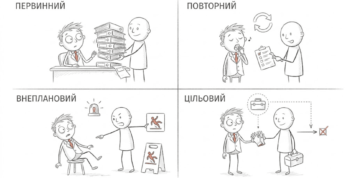
- unscheduled training — after emergencies, legal changes, or instruction updates.
Training format
Theory:
- first aid rules;
- legal responsibility;
- first-aid kit contents;
- responder safety principles.
Practice:
- typical scenario simulations;
- tourniquet use;
- bandaging;
- CPR;
- recovery position.
Best practice is training with medical professionals or certified trainers. After completion, issue a certificate to the employee.
Minimum skills every employee should have:
- CPR — 30 compressions + 2 breaths;
- bleeding control — pressure, tourniquet, dressing;
- recovery position — for unconsciousness;
- choking assistance — Heimlich maneuver;
- burn cooling — running water, no creams!;
- fracture immobilization — stabilize, do not move.
Employees must understand: the goal is not to “treat,” but to keep the person alive until professionals arrive.
Action algorithms for typical situations
In emergencies, people often panic. That’s why clear, simple step-by-step algorithms (without medical jargon) should be available to everyone.
Severe bleeding control
- Put on gloves.
- Identify the bleeding source.
- Apply direct pressure (sterile pad or hand).
- If bleeding doesn’t stop — apply a tourniquet above the wound.
- Record the time of application.
- Call 103.
CPR (cardiopulmonary resuscitation)
- Check responsiveness and breathing.
- If absent — call emergency services.
- Start CPR: 30 compressions → 2 breaths.
- Continue until the ambulance arrives or signs of life appear.
Choking (Heimlich maneuver)
- Ask: “Are you choking?”
- If the person can’t speak — stand behind them.
- Wrap arms around the abdomen, thrust upward sharply.
- Repeat until the object is expelled or the person loses consciousness.
- If unconscious — start CPR.
Burns
- Do not tear off clothing; do not apply cream.
- Cool under cool running water for 10–15 minutes.
- Cover with a sterile dressing.
- Avoid ice, fat/grease, or antiseptics.
- If the burn area is large — call emergency services.
Injury / fracture
- Do not move the injured part.
- Apply a splint or immobilize with improvised means.
- Limit movement and wait for the ambulance.
- Do not give painkillers without clear indications.
Shock
- Lay the person on their back.
- Raise the legs (if there are no injuries).
- Cover with a thermal blanket; do not give food.
- Give water only if the person is conscious and able to swallow.
- Monitor pulse and breathing.
When and how to call 103 / 112
Call immediately if:
- there is bleeding, burns, loss of consciousness, seizures, choking;
- severe chest pain;
- fractures;
- electric shock.
What to tell the dispatcher:
- address + entry point;
- number of injured persons;
- what happened + symptoms;
- your contact details.
AED at the workplace
Having an Automated External Defibrillator (AED) at a workplace can save a life in case of sudden cardiac arrest. While the law may not explicitly require companies to install AEDs, their use is a global best practice for large companies, offices, and public places.
Where is an AED especially useful?
- companies with a large number of employees (100+);
- sites with higher age-related risk or stressful working conditions;
- business centers, retail premises, warehouses, educational facilities;
- locations where ambulance access is difficult or slow.
How to train employees to use an AED?
AEDs are designed so that anyone can use them without medical knowledge. The device provides voice instructions in Ukrainian.
Still, employees should:
- review the instructions (posted near the device);
- attend a demonstration using a mannequin or trainer;
- include AED information in the first-aid training program.
Even if an AED is never used, its presence alone increases the workplace safety level.
Documents and links to OHS / Fire Safety
First-aid organization is part of the overall occupational safety system and must be formalized in documents. Without clear instructions, orders, maps, and appointments, everything stays “on paper.”
Key documents to have:
- Order on first-aid organization
Defines responsible persons, coverage areas, and training schedule. - Policy/procedure for providing first aid at the company
Regulates employee actions, kit locations, and content requirements. - First-aid instruction for employees
Added to job instructions and posted in accessible places. - First-aid training and briefing log
Includes theory and practical sessions. - Evacuation plan with first-aid kits and AED marked (if any)
Must be posted on each floor/zone. - First-aid kit inspection checklist
Includes dates, condition, expiry control, and signatures.
All documents should be kept by the OHS specialist and updated periodically.
Closing statement
Providing first aid is not a medical service — it’s part of a workplace safety culture. Properly equipped kits, trained employees, and clear instructions can be the difference between life and death.
What should you do right now?
- audit first-aid kits: availability, contents, accessibility, responsible persons;
- organize employee training: basic skills + hands-on practice;
- update documents, logs, and policies;
- mark first-aid kit locations on evacuation maps;
- consider installing an AED where appropriate.
Need support? Racio can provide:
- audits of first-aid kits and documentation per labor inspection requirements;
- hands-on first-aid training using mannequins;
- development of documents: policies, instructions, orders;
- AED consulting: when, where, how, and what model.
Contact us — we’ll help implement a first-aid system professionally, responsibly, and legally.
Q&A (FAQ)
Who should be responsible for first-aid kits?
Appointed by an employer order — typically an OHS specialist or authorized persons in departments.
How many kits are needed?
Depends on site size, risks, and shifts. Rule of thumb: access within 1–2 minutes.
How often should contents be updated?
Planned checks (monthly/quarterly) + unplanned after incidents; always control expiry dates.
Do we need an AED?
Recommended for large sites/high-risk settings; most effective within the first 3–5 minutes of sudden cardiac arrest.
Can we include painkillers/antibiotics?
Medicines only if approved and safe (non-prescription). Better focus on first-aid supplies and calling professionals.