
Welcome to the final episode of our premiere series on the initiation of a newly hired employee. This episode of our blockbuster series is dedicated to internship and duplication
Before we provide a step-by-step algorithm for conducting an internship or job shadowing, let’s figure out what it is and what is the difference between these phenomena?
The legislation says the next:
Internships – is the acquisition by a person of practical experience in performing production tasks and duties in the workplace at an enterprise after theoretical training before starting independent work under the direct supervision of an experienced employee.
Duplication – is the independent performance by an employee (understudy) of professional duties at the workplace under the supervision of an experienced employee with mandatory emergency and fire training.
Thus, internships are usually conducted for employees performing high-risk work, and duplication is carried out at facilities where the cost of error can be too high, such as power plants or railway dispatchers.
Let’s take a step-by-step look at how to conduct internships and duplication.
Step 1
Determine who needs an internship.
Opening Standard Regulations on the Procedure for Conducting Training and Testing of Knowledge on Occupational Safety and Health. It says that newly hired employees must undergo an internship AFTER the initial briefing at the workplace and BEFORE starting independent work.
Unfortunately, there is no single document that would answer the question: “Is it necessary to conduct an internship for %profession name%?”.
Legislation in the form of Standard Regulations on the Procedure for Conducting Training and Testing of Knowledge on Occupational Safety and Health gives us a very wide range of searches.
Here is this paragraph:
As a rule, internships or duplication are carried out during professional training for the right to perform high-risk work in cases provided for by labor protection regulations.
Let’s understand how to understand this paragraph using the example of an employee employed as a crane operator. Our search logic will be as follows:
- Let’s start by looking for a regulatory legal act that defines safety rules for this type of work. To do this, open the index of the NPAP and look for the rules for the operation of cranes – NPAP 0.00-1.80-18 Rules of labor protection during the operation of cranes, lifting devices and related equipment.
- We read the relevant NAPL and look for the requirements for employees, which state that they must undergo an internship before performing their duties.
Not all NPAPs require employees to undergo an internship. This usually happens if the employee performs specific work on some complex equipment.
That is, if you have office workers and you do not perform high-risk work, then your employees do not need to undergo an internship or backup. But if you perform work using a crane, forklift, press or any other technological equipment, we advise you to re-read the requirements of the relevant regulations and clarify whether there is a requirement for internships.
The law also states that the final list of positions and professions that must undergo an internship is determined by the head of the company. In other words, even if the NPAPP states that this profession must undergo an internship, the manager must issue a separate order to record this. Also, this order can include any other positions that do not have an internship requirement in the NPAPs, but you, as a manager, believe that it will not hurt these employees to have a little internship before they start working independently.
If you have employees who perform work related to ensuring the accident-free operation of high-risk facilities (thermal and nuclear power plants, mining enterprises, and other similar facilities, and, accordingly, violation of technological regimes of which poses a threat to employees and the environment), they must undergo backup training before starting independent work, with mandatory emergency and fire drills during this period in accordance with the emergency response plan.
Step 2
Who will conduct the internship or duplication and for how long?
The internship is conducted under the supervision of experienced, qualified employees.
Who can this be? For example, our crane operator can be trained by a senior crane operator.
As a rule, an internship is carried out for at least 2–15 shifts, and a secondment should last at least 6 shifts. The duration of both the internship and the secondment may vary (within the established limits of NOT less than, but NOT more than) – it all depends on what the employee will do and how the employer has determined in his/her order.
It is worth noting that the manager not only approves the list of positions and professions of employees who must undergo an internship (duplication), but also the duration of the internship (duplication).
Bad advice section:
We can also exempt a newly hired employee from completing an internship (duplication).
How to do it?
If an employee has at least 3 years of relevant work experience in this position or has simply transferred from another department and nothing has changed in his or her work, we can collectively decide not to conduct an internship.
What is the procedure, you may ask? It’s simple: the employer issues an order (instruction) exempting the employee from the internship or secondment.
Step 3
Where to do the internship?
You can hold it right at your workplace.
But if you are a new company and you don’t have that workplace, you can take advantage of the law and hold it at another company. These can be branches of your company, training centers, etc. Sounds interesting…… But don’t forget that this company should be as similar to yours as possible in terms of working conditions.
Step 4
We carry out the internship procedure (duplication).
Prior to the actual start of the internship, we need to obtain a security clearance.
How does it look like? ….
This is an order or instruction of the employer, which determines how many shifts the internship (duplication) will last and indicates the name and initials of the employee responsible for its conduct.
An example of an order (regulation)….
Like any other training, an internship should be based on an approved Program. What is it and what responsibilities of the employee should be described there?
In the process of internship (duplication), the employee must learn :
- How to operate the equipment safely;
- Technological and labor protection instructions;
- Procedures for dealing with production situations, both in normal and emergency conditions;
- Technological processes and methods of trouble-free equipment control.
This is what should be mentioned in the Program. Have you completed and mastered the program? Let’s move on to Step 5.
Step 5
We document the fact of the internship.
First, we check the employee’s knowledge. The algorithm for such a test is not established by law. We can conduct such a test at our own discretion. It can be online tests, handwritten tickets – whatever you want. If the employee has passed all your tests, we can allow him or her to work independently.
The final stage of the internship is an entry in the briefing log. When conducting an internship (duplication), fill in columns 10 and 11 in addition, write down how many shifts the employee listened to and have him or her sign it. Record your employee’s success by an order instruction from the director (or head of a structural unit). After this challenging and exciting stage, the employee can do the work independently.
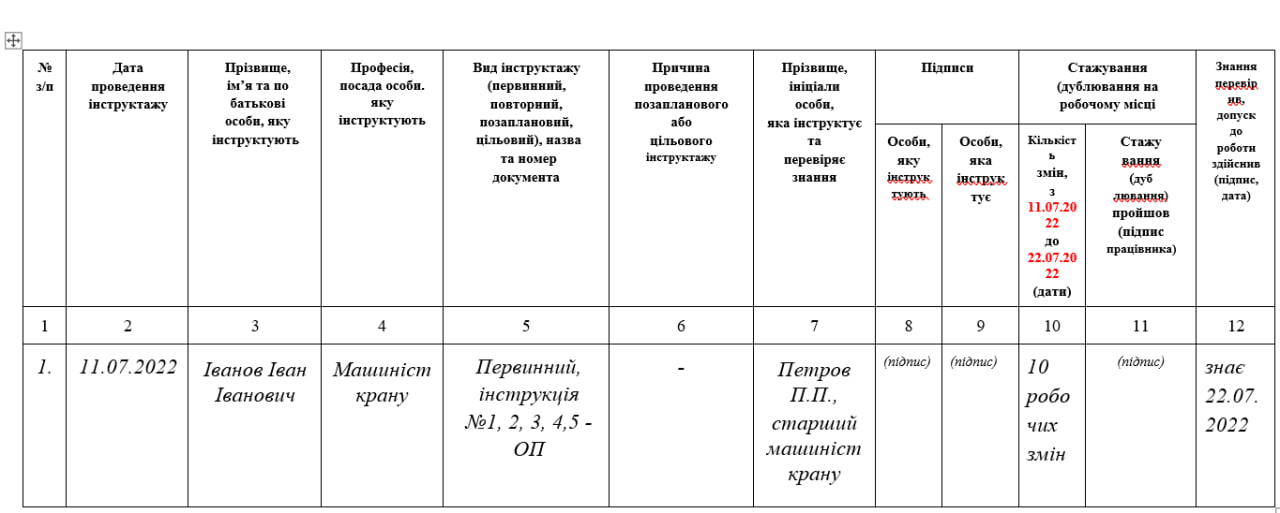
If you have told, shown, and tried, but the employee has not mastered the necessary production skills, we issue a new order (instruction) to extend the internship period and give them a second chance. Such an extension can last no more than two shifts. After that, we repeat the knowledge test again.
Congratulations, you have successfully read season 1 of this blockbuster, we are waiting for you in the next season, where we will tell you “How to conduct a re-instruction on occupational safety and health?”.

Kateryna Grimovych
Occupational health and safety engineer