Refresher training is like watching your favorite movie again, you already know the basic plot, but you will always find something new or well-forgotten. We invite you to dive into the exciting world of refresher training with our favorite step-by-step algorithms. Go!
Step 1
Determine when and to whom to conduct a second training session
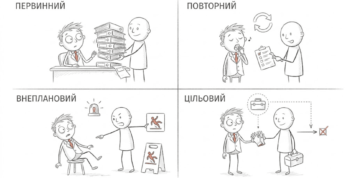
According to the law re-instruction is required once every SIX months but if your company is engaged in something more dangerous than just shifting papers, then once every 3 months. If you are not sure which category you belong to and whether your company performs such work, we suggest using the List of High Risk Work NPAPP 0.00-4.12-2005 where you will find all types of work that require briefing once a quarter.
Example…..
Let’s take the most common category of company that has office workers and warehouse workers. If everything is clear with office workers and we conduct training once every six months, what about warehouse workers?
If you are not sure who is doing what kind of work we suggest starting with an audit of the company – you will definitely see a lot of interesting things. If you see employees who operate forklifts, we instruct them accordingly – once every 3 months. Since such type of work as loading and unloading operations is included in the NPAPP 0.00-4.12-2005.
You 100% have a lot of other things to do, so create a reminder about the briefing. This can be a hand-drawn schedule posted in a public place, such as the kitchen (everyone should remember this event) or just a reminder in Google Calendar – you can use all your creativity here.
Step 2
Who will conduct the training and where?
It’s simple…. The same person who conducted the initial occupational safety briefing is the work supervisor (warehouse manager, production manager, director, etc.).
You can conduct one-on-one training or you can take advantage of the law and conduct it with a group of people who perform similar work such as all warehouse workers or all office employees.
The legislation does not require that the refresher training be held in a specific location, so it can be a meeting room, warehouse, kitchen or you can always take advantage of the digital world and hold such a meeting online.
Step 3
We conduct the briefing itself
When you refresher training, you don’t need to come up with new instructions or programs. You have already done it all before. In fact, we need to remind employees of the basic safety rules and requirements for safe work performance in accordance with the existing occupational safety and health instructions at the enterprise.
Unlike the initial training, the refresher training usually takes the form of a dialog where your employees are experienced and can share new facts or hazards they discovered while performing work and what to look out for.
For example, in addition to the warehouse, your company has a cold room where employees may enter from time to time. During the briefing, they may say that they need overalls with additional protection that you don’t have yet.
Use this opportunity to apply all the basics of management to analyze complaints and suggestions and improve working conditions. If people realize that their opinions are heard and taken into account, it will have a positive impact on both the overall safety culture and productivity.
Step 4
Document the fact of training
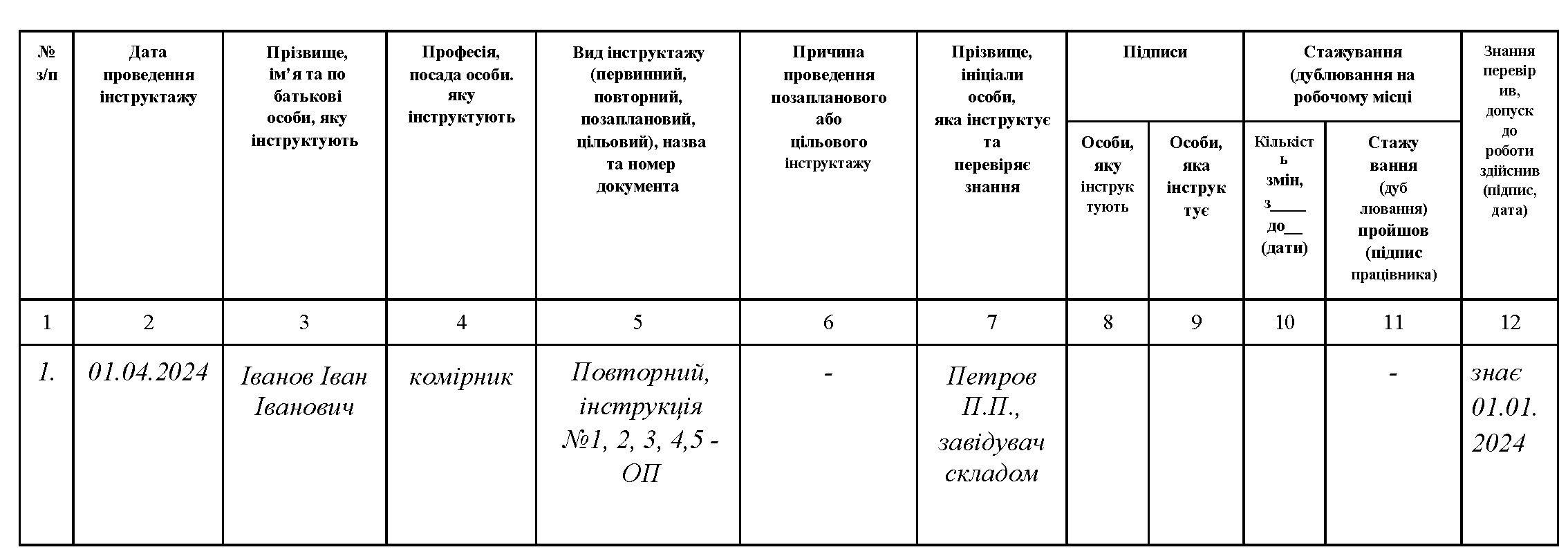
To do this, we need the Workplace Training Log, the one in which you recorded the initial training. When filling out the log, pay attention to what is indicated in the table header and fill it out in accordance with the requirements specified there.
Please note that column 5 should include all instructions under which the training was conducted. Successfully tested knowledge is recorded in column 12 of this log. The supervisor signs twice – in columns 9 and 12, and the employee signs only in column 8. A sample of a completed log of repeated briefings on labor protection.
How conduct re-instruction for employees who work remotely?
There are two options here:
First, if your employee does not use your company’s equipment, you do not need to conduct such a briefing.
Second, if you did give something to the employee, here’s a step-by-step algorithm on how to conduct a remote labor protection training:
- In the regulation on electronic document management (you must have such a document if your company has implemented electronic document management), describe in several paragraphs the procedure for signing occupational health and safety documentation.
- We draw up an employment contract that sets out the format of remote work.
- Approve the format of the briefing and document exchange by order.
- We provide online training.
- We exchange documents in accordance with clauses 1 and 3.
Importantly, your electronic documents should be stored in the same way as paper documents. This does not mean that you have to print them, but rather that you should use cloud solutions, store them on an email server or on a local computer. The retention period for paper logs is 10 years, so we can assume that digital evidence of your briefing should be kept for the same period of time, and this point should also be described in the regulation on electronic document management in the company. Whether it’s good news or not, it’s not clear what exactly these documents should look like. Therefore, until a specific format is established, we will use the established form of a paper journal, according to (Annex 6) of the Model Regulations.
The rubric is bad and not so bad advice:
You can exempt some employees from repeated occupational safety and health training. This is possible if they:
– Do not maintain facilities, machines, mechanisms, equipment;
– Do not use devices and tools;
– Do not engaged in the storage or processing of raw materials, materials, etc.
The list of positions of employees who are exempt from repeated briefings must be approved by an order of the employer at the enterprise. A sample of such an order…
Who can be so lucky?
Office employees: accountant, senior accountant, administrator, etc.
Does it mean that the article could be skipped? Yes, you could…
But we still recommend it, because timely re-instruction is like going to the doctor for prevention, it allows you to identify all the “pains” and prevent exacerbation.
If you want to conduct trainings in a clear and interesting way, we will be happy to help you.

Kateryna Grimovych
Occupational health and safety engineer